
Now that we’ve covered rhythm basics, let’s dive into one of the most essential building blocks of rhythm: simple meters and time signatures. These meters are the foundation of how we count, feel, and perform rhythms accurately. In this chapter, we’ll learn what simple meters are, how to read time signatures, and why understanding them is crucial for every musician and music student.
Regular Time Signatures
A regular time signature indicates that there are 2, 3, or 4 main beats per bar. In contrast, irregular time signatures have 5 or 7 main beats per bar. In this section, we’ll first focus on regular time signatures before exploring the more complex irregular ones.
How Many Beats Are in a Measure?
To better understand meter, we categorize it into duple, triple and quadruple meters – each referring to the number of main beats per measure (bar).
Duple meters = 2 main beats per measure. For example: 2/4, 6/8
Triple meters =3 main beats per measure. For example: 3/4, 9/8
Quadruple meters = 4 main beats per measure. For example: 4/2, 4/4 etc
Each beat can be broken into smaller parts – a process known as subdivision. So, at the first level, one beat splits into two equal parts. There smaller units can be divided further, creating even smaller subdivisions.
Simple vs. Compound Time Signatures
In simple meters, each beat divides into two equal subdivided beats (secondary beats) at the first level of division. The top number is usually 2, 3, or 4.
In compound meters, each beat divides into three equal subdivided beats at the first level of division. The top number is generally 6, 9, or 12. Additionally, as you go deeper into rhythm, even these subdivisions can broke down in further divisions.
How Time Signatures Work
Time Signatures (or meter signatures) express:
- How many beats are in each measure.
- The note value that represents one beat.
In Simple meters, first, the top number is 2, 3, or 4 and second, the bottom number often indicates the note value gets one beat, such as 2 (for half note), 4 (for quartet note), 8 (for eighth note), etc.
In the first measure, we have 2/2 time signature with the main beat-level counting. This means there are 2 main beats, each equivalent to 1 minim (half note).
In the second measure, we move to 1st subdivision-level counting. Here, 1 minim (half note) is divided into 2 crotchets (quarters notes).
In the third measure, we have 2nd subdivision-level counting, where 1 minim is divided into 4 quavers (eighth notes).
This pattern continues for the other time signatures shown in the example:
1st measure: Main beat-level counting
2nd measure: First subdivision-level counting
3rd measure: Second subdivision-level counting
Simple Duple Meters
Duple meter means the main beats grouped in twos.


Simple Triple Meters
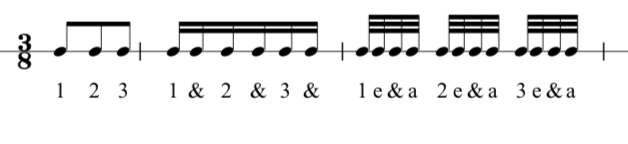
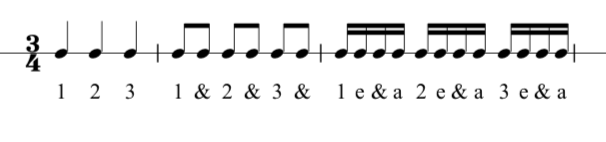
Triple meter means the beats grouped in threes (see the first measure for an example).

Simple Quadruple Meters
Quadruple meter means the beats grouped in fours.



As we can see, each main beat divides into two subdivised-beats, and at the second subdivision level, each main beat divides into four smaller beats.
In conclusion
A key rule: in simple meters, every beat divides cleanly into two.
This makes them predictable and easy to count – perfect for beginners and experienced musicians alike.
Thanks so much for studying with me! If you enjoyed this post and want to keep learning, you can support my work by buying me a coffee. As a thank-you, you’ll receive subscription-based music theory lessons, complete with printable PDFs, weekly extra exercises, and answer sheets to keep you progressing.
Looking for more? You’ll find a wide range of PDF printable worksheets in my Etsy shop, perfect for practice at home or in the classroom.
Thank you again for your support—and happy practicing!
– Helena