
Music isn’t just notes in a staff – it’s how they “dance” together! You’ve learned to read treble and bass clefs, and now it’s time to feel the rhythm. Last time, we boxed beats into measures. Today, we’ll see how those beats group up. They make songs march or sway. Welcome to simple and compound meters!
The Difference Between Measures and Meters
Measures: The Boxes of Beats
What are they: Measures are the little sections on the staff that group beats together. They are separated by bar lines. Think of them as containers- like boxes on a conveyor belt holding a set number of beats.
How they work: A measure’s length depends on the time signature (e.g. 4/4 means 4 beats per measure). If you want a reminder just jump back to Post 3!
Strong and Weak Beats
In music, certain beats within a measure are perceived as more or less emphasised. These are commonly referred to as “strong” or “weak” beats. This perception depends on the time signature. The time signature determines how the beats are organised. It also affects how their relative strength is felt.

This creates a sense of movement and rhythmic flow.
Meters: The Pattern of Beats
Meter refers to the ratio that determines how beats are grouped. It indicates what type of note shows the pulse. Expressed in music through a time signature, meter determines how beats are organized within a piece. It determines the basic unit of pulse. It specifies which note value shows the beat, such as a quartet note or eighth note. It also dictates how beats are grouped, arranging them into repeating patterns called measures or bars. Additionally, meter influences how beats subdivide. Each beat can be broken down into smaller rhythmic values. This shapes the overall feel of the music.
Understanding Meter in Music: Simple & Compound
So lets make a reminder: Meter is the way beats are organized and structured in music. It determines:
- How many beats are in each measure (or bar).
- How beats are grouped (duple, triple, or quadruple).
- How beats are subdivided (simple or compound).
The combination of grouping and subdivision defines the meter of a piece.
Simple vs Compound Meter
The key difference between simple and compound meter is how each beat is subdivided:
Simple Meter: Each beat divides into two equal parts.

Compound Meter: Each beat divides into three equal parts.

A quick trick to find meter:
- If the top number of the time signature is 2, 3, or 4, it’s Simple Meter.
- If the top number is 6, 9, or 12, it’s Compound Meter. Is a multiple of 3. For example, in 6/8, 6/3=2, meaning there are two beats per measure, each subdivided into three parts!
Practical Exercise:
Try tapping 1 – 2 – 1 – 2 steadily. If you can subdivide each beat into 1 & 2 &, that’s simple meter.
Now try tapping 1 – 2 – 3 – 1 – 2 – 3 with a swaying motion. That’s compound meter.
| Meter Type | Number of Beats per Measure | Example Time Signatures | Example Songs |
|---|
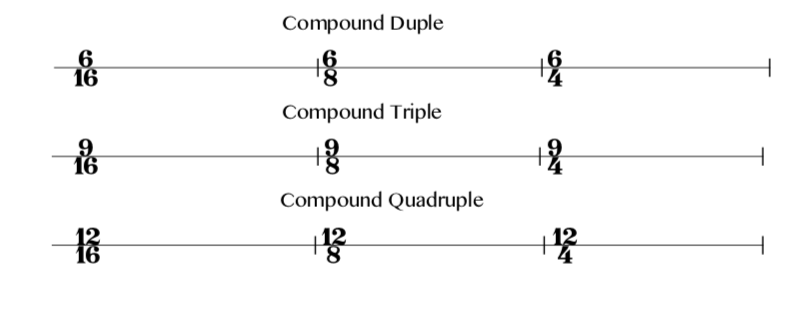
| Duple Meter | 2 beats per measure | 2/4 (Simple Duple) 6/8 (Compound Duple) | “Yankee Doodle” (2/4), “Row, Row, Row Your Boat” (6/8) |
| Triple Meter | 3 beats per measure | 3/4 (Simple Triple) 9/8 (Compound Triple) | “Silent Night” (3/4), “The Blue Danube” (9/8) |
| Quadruple Meter | 4 beats per measure | 4/4 (Simple Quadruple) 12/8 (Compound Quadruple) | “Let It Be” (4/4), “We Are the Champions” (12/8) |

Example:
- 4/4 (Simple Quadruple): Each beat divides into two eighth notes.
- 6/8 (Compound Duple): Each beat divides into three eighth notes.
Some famous pieces for better understanding the simple and compound meters! Just press play button!
Duple Meter (2 Beats per Measure)
Duple meter is characterized by its march-like feel because it consists of two beats per measure. It is commonly found in:
- Marches (“Stars and Stripes Forever” – John Philip Sousa)
- Folk Songs (“Yankee Doodle”)
- Pop & Rock (“We Will Rock You” – Queen)
Simple Duple (2/4)

- 2 beats per measure, each divided into 2 (quarter notes → eighth notes)
- Example: “Twinkle, Twinkle, Little Star”
Compound Duple (6/8)
- 2 beats per measure, each divided into 3 (dotted quarter notes → eighth notes)
- Example: “Row, Row, Row Your Boat”
In 6/8, eighth notes are grouped in sets of three. As a compound meter, we have a division of the beat unit. The beat unit in 6/8 is a dotted crochet (dotted quarter note) and one dotted crochet can be divided into three eighth notes. So, Three eighth notes= One dotted crochet. 2 groups of three eighth notes = 2 dotted crochets. We count two beats because each measure contains two dotted crochet beats.
Triple Meter (3 Beats per Measure)
Triple meter has a waltz-like feel and is commonly found in:
- Waltzes (“Blue Danube Waltz” – Johann Strauss II)
- Classical music (“Minuet in G” – Bach)
- Lullabies (“Brahms’ Lullaby”)
Simple Triple (3/4)
- 3 beats per measure, each divided into 2
- Example: “Silent Night”
In a simple triple meter there is no need to divide the beat unit. In 3/4, there are three beat per measure, and each beat is represented be a crochet (quarter note). So we count the beats: 1, 2, 3. The pattern of the beats is: Strong – Weak – Weak.
Compound Triple (9/8)
- 3 beats per measure, each divided into 3
- Example: “Jesu, Joy of Man’s Desiring” – J.S. Bach
9/8 is a compound triple meter. Eighth notes are grouped is sets of three. According to the rule of beat division in compound meters, each group eighth notes forms one beat. Each beat is a dotted crochet (dotted quarter note), which divides into three eighth notes. So, 9/8 has three beats per measure.
Quadruple Meter (4 Beats per Measure)
Quadruple meter feels steady and natural to most listeners and is the most common in Western music. Found in:
- Most pop and rock music (“Imagine” – John Lennon, “Let It Be” – The Beatles)
- National anthems (“The Star-Spangled Banner”)
- Dance music (“Uptown Funk” – Bruno Mars)
Simple Quadruple (4/4)
- 4 beats per measure, each divided into 2
- Example: “Let It Be”
The beat unit in this meter is a single crochet (quarter note). In each measure, we have four crochets. In a simple meter, we don’t have to divide the beat unit further. So we count the beats: 1, 2, 3, 4 – one beat for each crochet note. To sum up: 4/4 is a simple meter with 4 beats per measure.
Compound Quadruple (12/8)
- 4 beats per measure, each divided into 3
- Example: “We Are the Champions” – Queen
Don’t worry if this feels like a lot of information. Understanding meter and rhythm takes time. It becomes much clearer with practice! The key is to listen, feel the pulse, and try clapping or tapping along to different pieces of music.
Real-World Analogy:
Measures: Boxes of chocolates on a shelf-each box holds a set amount.
Meters: How the chocolates are arranged inside-rows of 4 (simple) or clusters of 3 (compound)
To help you get started, I’ve created a free PDF with rhythmic solfège exercises covering the basic meters we discussed in this post. Download it to practice and reinforce what you’ve learned!
Support My Work: If you enjoyed this post and want to see more, check out my Etsy shop for a variety of piano music sheets and music theory exercises! You can also Buy Me a Coffee to support weekly lessons, theory, and exercises. Your support keeps the music going!