
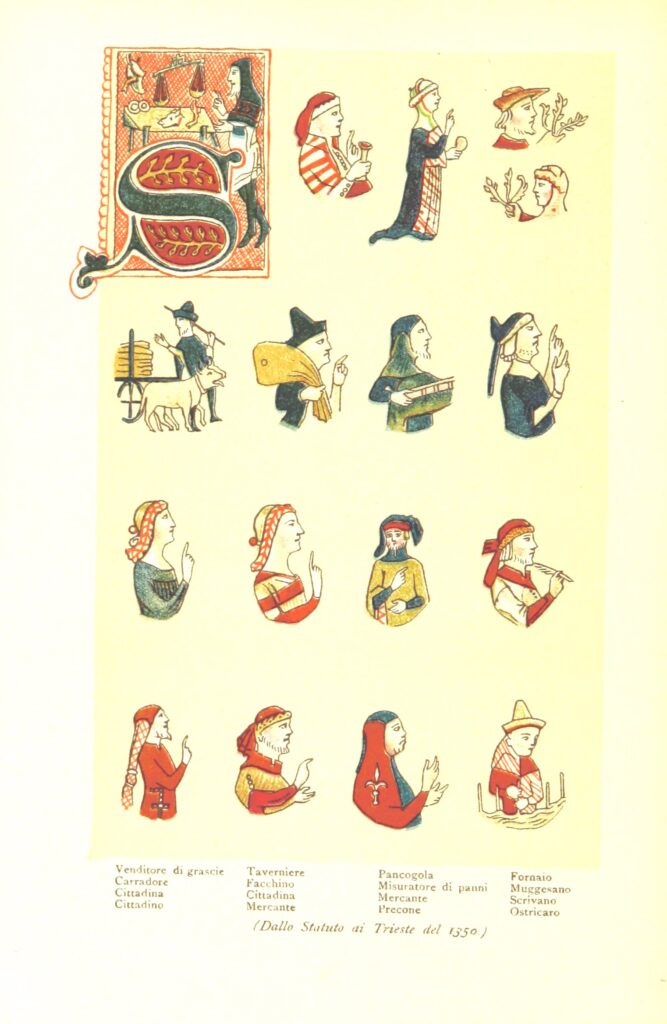
Time period: 6th century (c. 450) – 1450 AD
After the fall of the Roman Empire and the establishment of Christianity across the European continent, Europe entered a long period often described as one of stagnation. The Crusades, the invasions of barbarian tribes, the Hundred Years’ War between England and France, poor living conditions, and the outbreak of the Black Death made people highly vulnerable to disease and pandemics that deeply affected society.
The feudal system divided society into rigid social classes, ranging from very wealthy and privileged elites to extremely poor populations. As a result of these conditions, social development progressed slowly. However, the Middle Ages also marked important changes: the foundation of universities, the growth of trade, and the emergence of the first cities. These developments gradually transformed social structures, and alongside them, artistic expression began to change.
(For this reason, before focusing on music history, it is important to understand the broader historical and social context in which art developed during this period.)
Medieval Music and the Emerge of Polyphony
The medieval period in music marks the beginning of polyphony. Through both sacred and secular music, the first attempts to move away from monophony begin to appear. The Middle Ages is a crucial period for the development of musical notation and for the first steps toward contrapuntal composition.
Early Middle Ages (6th–9th Century): Byzantine Music.
During the early Middle Ages, Byzantine music was predominant. The term “Byzantine music” refers to the music of the Eastern Orthodox Church.
Byzantine music is monophonic and vocal, performed either by a solo chanter or a choir, without the use of musical instruments. In contrast, secular music of the same period did include instruments. The notes are named pa, vou, ga, di, ke, zo, ni. Psalmody, inherited from earlier periods, continued as a purely monophonic form of composition.
The scales used during this period are the ecclesiastical modes. There are eight modes, and the term “modes,” whether ecclesiastical or ancient Greek, refers to the relationships between the notes within a scale.
The notation system used did not define exact pitch or duration. There was no division into measures; instead, certain signs indicated time and expression. Rhythm was free.
The main musical forms were psalms, alleluias, and hymns. Byzantine music underwent major changes in both notation and performance practice over the centuries and continued to evolve. This overview is only a brief introduction. Byzantine music is a vast field within music history, and many specialized scholars have studied it in depth, offering far more detailed and comprehensive knowledge.
Up to the 4th and 5th centuries, Byzantine chant used ekphonetic notation. In the 8th century, hook-shaped notation appeared, associated with John of Damascus. From 1814 onward, the form of notation established at that time remains in use today.
More about: https://gregorio-project.github.io/
https://gregorian-chant-hymns.com/
Ambrosian and Gregorian Chant in the West
In Western liturgical music, Ambrosian and Gregorian chant developed as the main forms of sacred monophonic music.
In the 4th century, the Bishop of Milan, Ambrose, grouped and organized the liturgical hymns of the Western Church. This repertoire became known as Ambrosian chant. The main language of the texts was Latin, although some hymns also existed in Greek and Hebrew.
In the 6th century, Pope Gregory the Great introduced further reforms in church music. He began collecting, correcting, and codifying hymns and psalms in order to reduce confusion and achieve unity within the Western Church. This process led to what is known as Gregorian chant.
Gregorian chant became dominant in Central and Western Europe and took a more defined form between the late 6th and early 7th centuries. It is monophonic, rhythmically free, and not divided into measures. Each note usually corresponds to one syllable, except in melismatic passages, where a single syllable is sung over multiple notes (κάθε συλλαβή μία ολόκληρη μουσική φράση) , such as the “a” in Alleluia. The texts are in Latin, the rhythm is free, and ecclesiastical modes are used. Neumatic notation was employed, as square notation and modern staff notation had not yet fully developed.
Characteristics of Gregorian Chant
Musical Notation
Before the development of notation, musical transmission relied entirely on memory. In order to preserve musical forms and ensure consistency, a notation system became necessary. Initially, neumes were written above the text to indicate the rise and fall of the melody, rather than precise pitch or duration.
In Gregorian chant, neumatic notation was used first, followed later by square notation. In both systems, pitch could be identified, but not exact rhythmic duration.
A significant development occurred when an unknown monk introduced a horizontal line to indicate a fixed pitch, often F. The distance of the notes from this line helped performers understand relative pitch. Additional lines were later added, sometimes in different colors, each representing a specific pitch. This system greatly assisted singers.
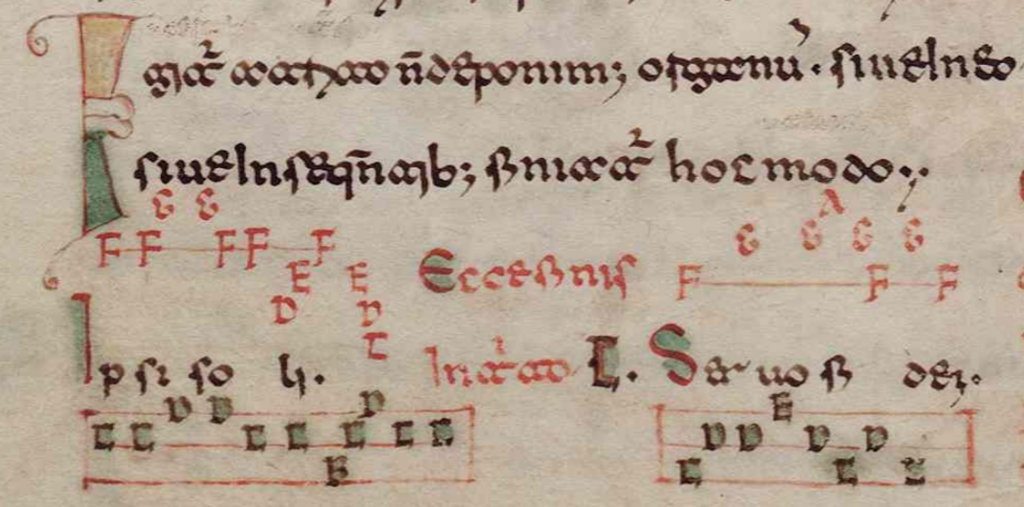
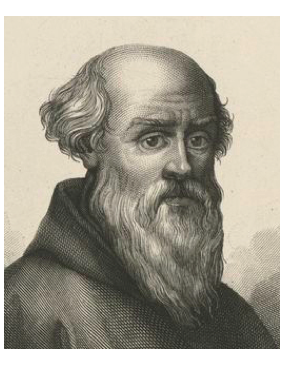
In the 11th century, Guido of Arezzo, a music theorist of the time, contributed significantly to notation. He developed the four-line staff to establish stable pitch reference. A yellow line indicated C, a black line another C, and a red line indicated F. He is also associated with the naming of the notes, derived from the first syllables of the hymn to Saint John: ut (later renamed do), re, mi, fa, sol, la. The note si was added later, after the 16th century. Guido’s system gradually evolved into the modern five-line staff.
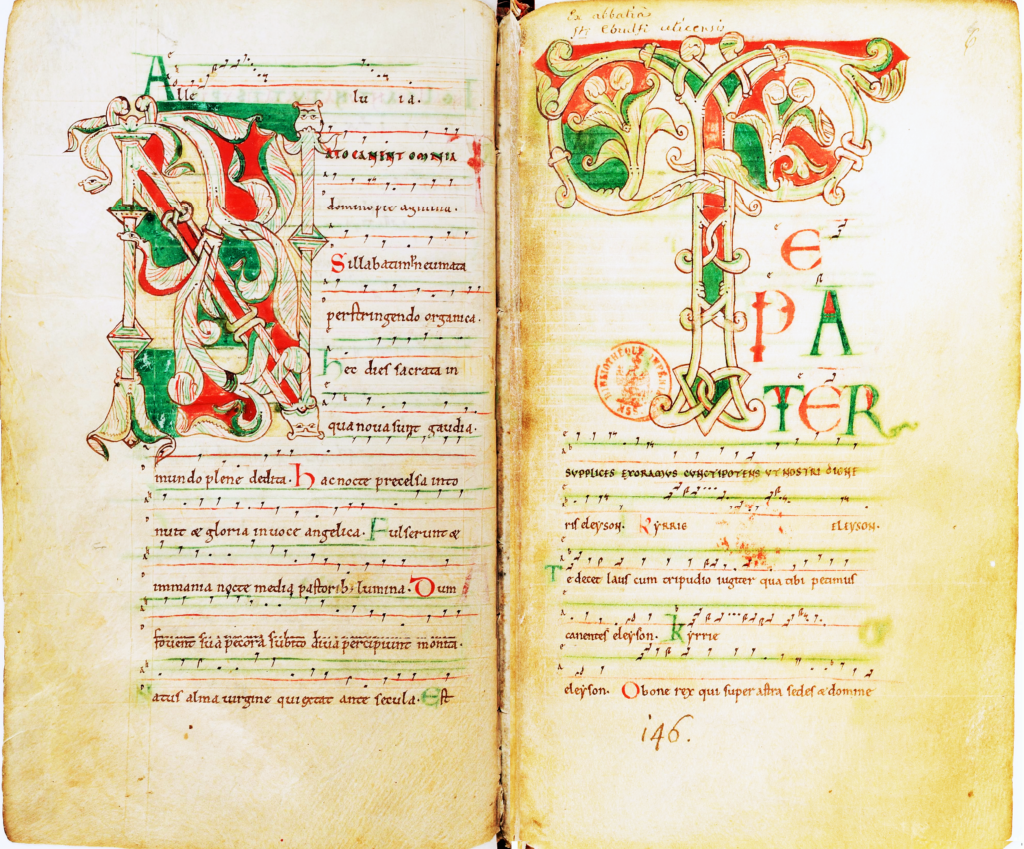
Despite these advances, notes still did not have fixed rhythmic values; notation defined pitch but not duration. Modern musical notation in its current form has been in use since 1814.
UT queant laxis
RE sonare fibris,
MI ra gestorum
FA muli tuorum,
SOL ve polluti
LA bii reatum,
Sancte Iohannes!
For further study, one may explore the Guidonian Hand, an important pedagogical tool attributed to Guido of Arezzo.

Manuscrits numérisés de la Bibliothèque municipale de Toulouse. Manuscrits. Ordo missalis secundum consuetudinem curie Romane (contient la Messe de Toulouse) // Publication date : 1301-1400 : https://gallica.bnf.fr/ark:/12148/btv1b105600662
Early Polyphony and Organum (9th–11th Century)
Around the 9th century (c. 850), polyphonic music began to emerge. The simplest form of polyphony was organum.
The treatise Musica enchiriadis, written in the 9th century by an anonymous author, describes early organum. In this early practice, the chant melody, which later became known as the cantus firmus, often appeared in the upper voice, while an added voice moved at a fixed interval below.
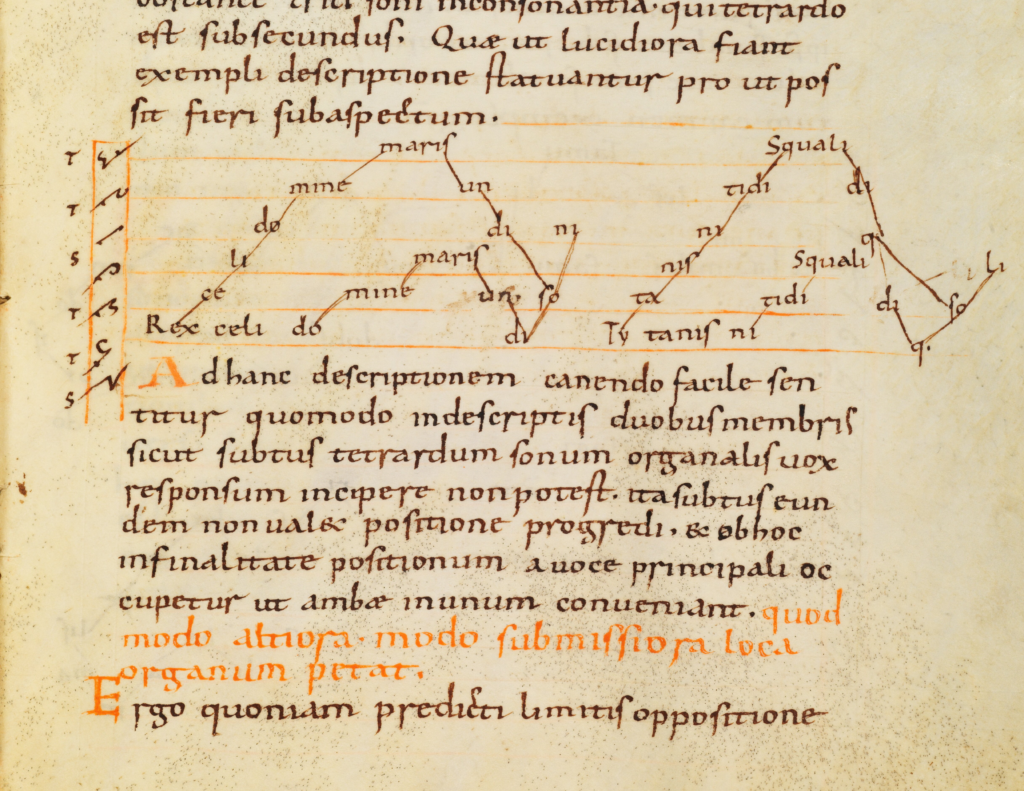
Although Musica enchiriadis discusses organum in the 9th century, organum as a more developed compositional practice evolved gradually and became more established between the 11th and 12th centuries.
The term cantus firmus (“fixed melody”) refers to a pre-existing melody that forms the basis of a polyphonic composition. In Musica enchiriadis, the chant functioned as the structural foundation of the music, even though its position differed from later practice. Around the 11th century, the chant typically moved to the lowest voice. Later, it often appeared in the tenor voice (from tenere, “to hold”), where it sustained long note values.
In organum around 1200 AD, the lower voice (or tenor) sang a Gregorian chant in long note durations and very slow tempo, one syllable at a time. This chant functioned as the cantus firmus. Above it, the upper voice sang a new melody, often influenced by secular music, with more movement, smaller note values, and a more regular rhythm.
Why Was Gregorian Chant So Simple?
The widespread dissemination of Gregorian chant was largely due to the simplicity of its melodies. These melodies were easy to memorize and accessible even to people outside formal ecclesiastical education, without requiring literacy or advanced musical study. At the same time, Gregorian chant served as part of an expansionist policy aimed at religious unification across different regions.
Further study:
Cantatorium, CH-SGs Cod. Sang. 359 (Gregorian Chant): https://imslp.org/wiki/Special:ReverseLookup/288542
Secular Music in the Middle Ages (1100–1300)
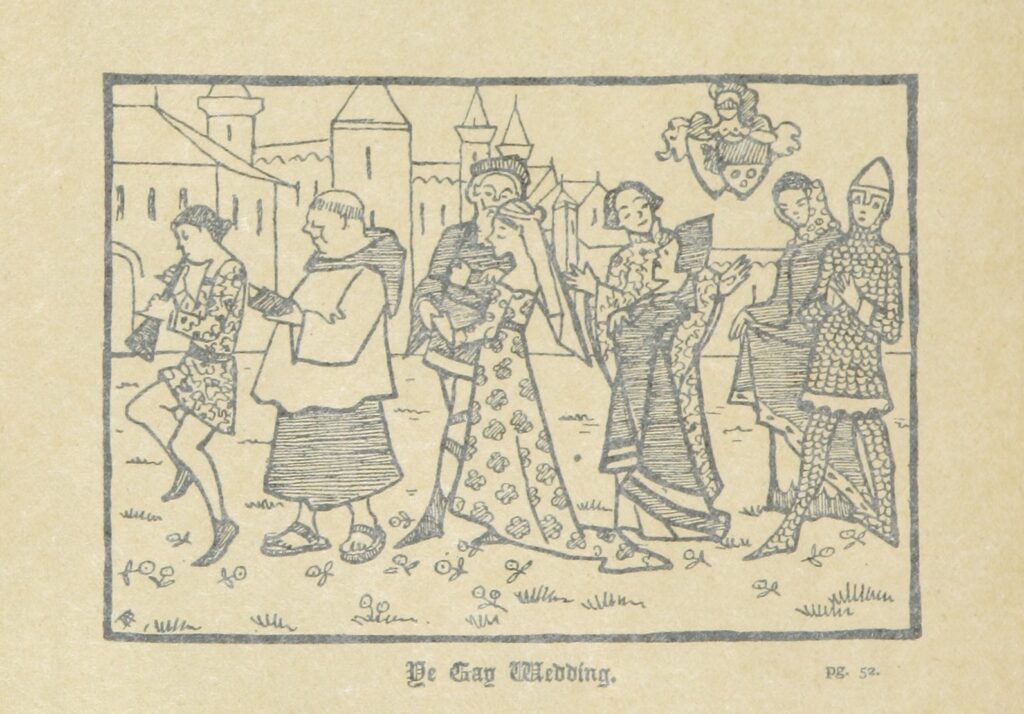
During the Middle Ages, particularly between the 11th and 13th centuries, secular music flourished alongside sacred traditions. With the Crusades, the art of the troubadours and trouvères emerged. Troubadours originated in southern France, while trouvères came from northern France. In Germany, Minnesingers appeared during the 13th century.
Their songs were usually poetic texts written by the composers themselves and dealt with themes of love, satire, politics, or praise of knightly deeds.
Because most people in the Middle Ages could not study music for entertainment, professional musicians known as minstrels played an important role. Minstrels were both singers and instrumentalists. In the early Middle Ages, these traveling performers entertained rulers or were invited to festivals, popular celebrations, and public events.
Performance was often semi-improvised, as musical notation was not yet fully developed. Minstrels contributed significantly to musical evolution by traveling constantly and encountering different musical traditions. As a result, musical idioms spread between regions, enriching local repertoires.
Since much of the population was illiterate, many compositions and songs from this period were never written down and have been lost. The songs that were preserved were not divided into measures until around 1250, when fractional values were introduced to better accompany dance.
Differences Between Sacred and Secular Music
Secular music is music free from religious texts. It was performed at various social events and for dancing. One of the most important differences between sacred and secular music is the use of musical instruments, which were common in secular contexts but excluded from church music.
Additionally, secular music varies greatly in theme and style depending on the occasion, while sacred music follows strict liturgical and stylistic conventions. Instrumental accompaniment and thematic flexibility distinguish secular music from religious music during the Middle Ages.
With this article, we complete the first chapter of Medieval Music. In the next post, we will continue with the Ars Antiqua and Ars Nova periods, explore the Notre Dame School, and look at the main musical instruments of the period, diving deeper into polyphony and the early compositional techniques that led to the Renaissance of music.
If you would like to support my work, you can find me on Buy Me a Coffee for a small coffee
You can also download a PDF worksheet for Medieval Music here to summarize and take notes from this chapter.
Thank you for reading and sharing this journey through the music of the Middle Ages!
Helena