
F Major
Like the previous scales (G & D) we’ll study and “build” the F Major! We start by writing the first note, the tonic F. Then, we continue writing the notes step by step. Our aim is to reach the F one octave higher! To make this scale sound major, we apply the Tone-Semitone patterns between each pair of neighbouring notes. Observing the notes, we see that the interval between the 3rd (A) and 4th (B) degrees, is a whole tone. However, according to the major scale pattern, this interval should be a semitone. To correct this, we lower B by adding a flat (B♭), making the interval A – B♭ a semitone.
But why did we lower B with a flat instead of raising A with a sharp? If we raised A to A♯, the interval between G and A♯ would become a tone and a semitone instead of a whole tone, which does not follow the major scale formula.
So, the key signature of F Major is B flat. As mentioned before, key signature include both sharps and flats.
Major scales can be divided into two categories based on their key signatures:
- Scales with sharps (♯) in their key signature (e.g., G Major, D Major, A Major).
- Scales with flats (♭) in their key signature (e.g., F Major, B♭ Major, E♭ Major).
Each major scale follows the same pattern of whole Tone and semitone, but the accidentals (sharps or flats) in the key signature determine which category the scale belongs to.


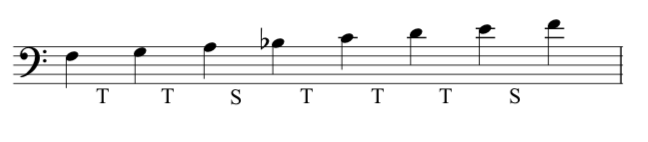
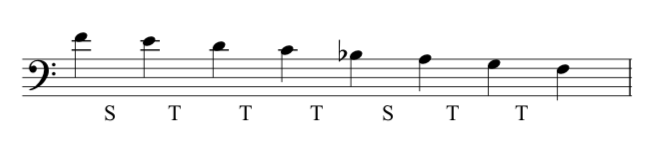


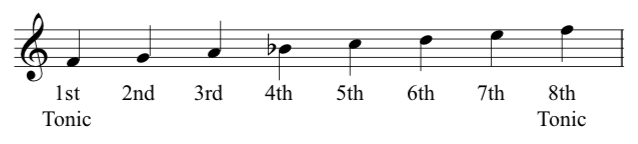

We must pay attention to the 4th interval, as it contains B♭ as the top note.
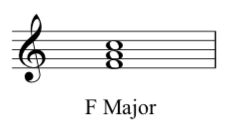
In F Major, the tonic triad consists of:
- Root: F
- Third: A
- Fifth: C


Support My Work: If you enjoyed this post and want to see more, check out my Etsy shop for a variety of piano music sheets and music theory exercises! You can also Buy Me a Coffee to support weekly lessons, theory, and exercises. Your support keeps the music going!