After learning about major scales with sharps and flats, it is time to explore enharmonic scales. Understanding these scales is essential to fully grasp the Circle of Fifths and how all key signatures relate.
Enharmonic Scales
Now that we have analysed major scales and their key signatures with sharps and flats, let’s talk about enharmonic scales.
Understanding Enharmonic Scales
Enharmonic scales have a different key note and key signature, but they sound exactly the same. On the piano, the same keys produce the same pitches. Theoretical naming makes them appear different, but they are identical in sound.
Studying enharmonic scales helps you:
Understand the full logic of the Circle of Fifths.
Recognize every possible key signature.
Connect the “sharp side” and “flat side” of the Circle.
Enharmonic Major Scales
Common Enharmonic Pairs
F♯ Major ↔ G♭ Major
F♯ is the key note of F♯ Major.
G♭ is the key note of G♭ Major.
F♯ Major has six sharps; G♭ Major has six flats.
Different key names and key signatures, but the two scales sound exactly the same.
Every note in both scales corresponds to the same piano key.
C♯ Major ↔ D♭ Major
B Major ↔ C♭ Major
In classical music, only these three enharmonic major pairs are commonly used: F♯/G♭, C♯/D♭, B/C♭.
Theoritical Scales
Some enharmonic scales are considered theoretical. They exist only on paper because writing them requires too many sharps, flats, or even double sharps and double flats. Musicians do not use these scales in real notation or performance. Their main purpose is theoretical: they show how the Circle of Fifths continues in both directions. Theoretical scales also help us understand how enharmonic equivalents connect the “sharp side” and the “flat side” of the Circle. Including these scales in study allows you to see the full logic of the Circle of Fifths and understand how all key signatures relate to each other, even the ones we rarely encounter in practice.
G♯ Major ↔ A♭ Major
G♯ Major is theoretical because it requires an F double sharp.
Double sharps are not part of standard key signatures.
In practice, musicians use A♭ Major instead.
D♯ Major ↔ E♭ Major
D♯ Major requires F double sharp and C double sharp.
These extra accidentals do not appear in standard notation.
E♭ Major is used in real music.
A♯ Major ↔ B♭ Major
A♯ Major requires F, C, G double sharp.
B♭ Major is used instead.
E♯ Major ↔ F Major
B♯ Major ↔ C Major
Theoretical scales include all sharps or flats of a standard key signature plus any required double sharps or double flats to maintain the correct pattern of whole and half steps.
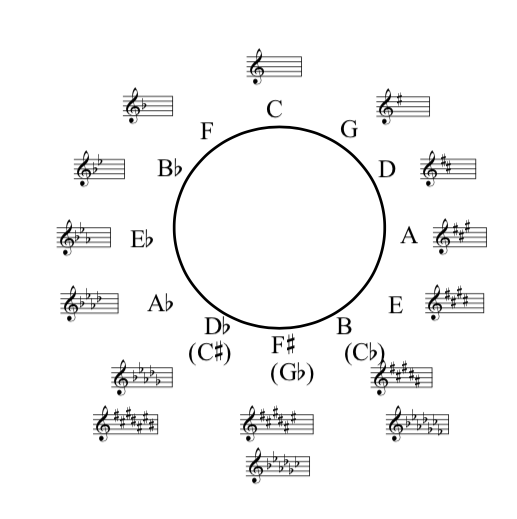
The sequence of sharp key signatures can include enharmonic equivalents, shown with smaller notes as alternative names. Using enharmonic scales, this sequence can also be reversed to form the sequence of flat key signatures. Both sequences ultimately lead back to C Major.
Enharmonic Sequences and the Circle of Fifths
The Circle of Fifths is a visual map of all twelve pitches in music. To understand it easily, think of it as a clock. At the very top (12 o’clock), we place C Major.
How the “Clock” Works
The Circle of Fifths diagram helps visualize the relationship between all twelve keys. To find the keys with sharps, we move clockwise. Each step represents an interval of a perfect fifth up.
Starting at C (12 o’clock), one fifth up takes us to G (1 o’clock).
Moving another fifth up takes us to D (2 o’clock).
Reading the circle clockwise shows the sequence of key signatures with sharps. Conversely, reading counter-clockwise from C shows the sequence with flats. Each step in this direction is a perfect fifth down.
This pattern allows you to predict key signatures quickly. Furthermore, it helps you see how all keys connect through enharmonic equivalents (like F# and Gb) at the bottom of the circle. Understanding these distances is essential for recognising the key signature of any scale instantly.
Relative Majors and Minors
One of the most important features of the circle is the relationship between Major and Minor keys. Every major key has a Relative Minor. These two scales are inseparable because they share the same key signature.
To find the relative minor, move a minor third down from the Major key. Conversely, move a minor third up from a minor key to find its Major relative. Since they share the same sharps or flats, they occupy the same position on our musical clock.
Modulation: Moving Between Keys
The Circle of Fifths is a vital tool for modulation. This is the process of shifting the tonal center from one key to another.
Usually, composers modulate to closely related keys. These are keys that sit right nect to each other on the circle. However, music from the 19th century and later often explores distantly related keys. These are often a tritone away on the circle. This creates a more dramatic and modern sound.
Chord Progression and Root Motion
Finally, the circle helps us understand chord prograssions. The circle of fifths progression is very familiar in Baroque era music. Many famous compositions rely on “root motion by fifths”. If we treat each pitch on the circle as the root of a chord, we can create a powerful sequence of harmonies.
The Circle of Fifths diagram makes this easier to understand:
Clockwise, each key is a perfect 5th higher → sharp key signatures
Counterclockwise, each key is a perfect 5th below → flat key signatures
Conclusion
The Circle of Fifths diagram helps visualize this relationship clearly. Reading the circle clockwise shows the sequence of key signatures with sharps. Reading counterclockwise shows the sequence with flats. Understanding this pattern allows you to predict key signatures quickly and see how all keys connect through enharmonic equivalents.