
Mastering Melody Transposition Between Treble & Bass Clefs While Maintaining Pitch
Pitch is a fundamental element of sound. It plays a crucial role in music when organized within a musical context, as we discussed in an earlier post. It is a perception of how high or low a note sounds. This perception is determined by the frequency of vibrations. In written music, clefs help us organize pitches on the staff. The treble clef is typically used for higher-pitched instruments and voices, while the bass clef is for lower-pitched ones.
Steps to Transpose Without Changing Pitch:
Find the Notes in One Clef: Write out the melody in either the treble or bass clef.
Find the Corresponding Notes in the Other Clef:
- Middle C (C4) is the key reference point.
- A note that appears on a certain line or space in one clef will be placed differently in the other.
Rewrite the Melody in the New Clef: Ensure that each note appears at its equivalent position, keeping the pitch unchanged.
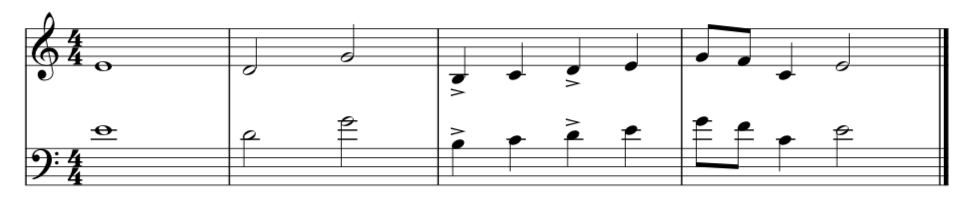
This technique is commonly used in instrumental arrangements. It is also used by musicians who need to switch between clefs, such as pianists and vocalists.
You can learn more about note naming and clefs in our previous post. If you’re looking for practice, check out our printable PDF exercises on note names in both treble and bass clefs!
Want to practice? Check out transposition exercises bundle for clefs and notes, perfect for grade 2 music theory practice!