
Now that we’ve covered rhythm basics, let’s dive into one of the most essential building blocks of rhythm: simple meters and time signatures. These meters are the foundation of how we count, feel, and perform rhythms accurately. In this chapter, we’ll learn what simple meters are, how to read time signatures, and why understanding them…
Author: Helena Papapostolou
Compound Meter & Time Signatures
In this lesson, we will explore compound meters. Unlike simple meters, where each beats divides into two equal parts, in compound meters, each main beat naturally divides into three equal parts. What are Compound Meters? Compound meters are time signatures where the top number is a multiple of 3. In simple meters, the top number…
The Curved Line in Music: Slur or Tie?
Slurs and ties look almost identical, but they serve two completely different roles in music notation. In this post, we’ll explore what each symbol means, how to distinguish them, and how they affect rhythm and phrasing – plus how they’re connected to syncopation and beats structure. What Is a Slur? A slur is a curved…
5. Feeling the Rhythm – Simple and Compound Meters
Music isn’t just notes in a staff – it’s how they “dance” together! You’ve learned to read treble and bass clefs, and now it’s time to feel the rhythm. Last time, we boxed beats into measures. Today, we’ll see how those beats group up. They make songs march or sway. Welcome to simple and compound…
Meet Helena: My Musical & Academic Journey!
Hi! I’m Helena from Thessaloniki, Greece! My journey in music started at a young age with the piano. Over the years, I’ve dedicated my life to teaching and studying music in depth. I’ve studied and graduated from Conservatories with a Piano Soloist’s Diploma and Composition Diploma. I’ve also earned degrees in Big Band Conducting, School…
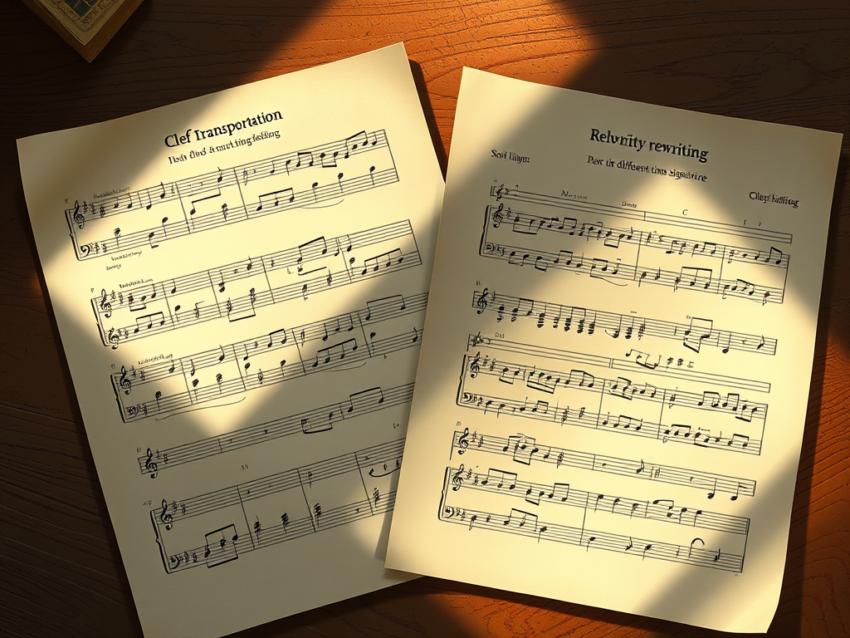
Grade 2 Music Theory: Download PDF Exercises for Clef Transposition & Rewriting a Melody
Here you can instantly download two free printable PDF exercises. They are designed specifically for practicing Clef Transposition and they also focus on the essential skill of rewriting a melody in a different time signature! These resources will greatly enhance your musical abilities and understanding. Discover more in-depth information about the process of rewriting a…
8.c. A Major Basics – Scales, Arpeggios and Triads for Grade 2
Another major we will study is the A Major scale. A Major starts from the note A and write the notes in order, up to A an octave higher. First, we notice that E-F interval is a natural semitone. To form the major scale, we observe that the interval C-D is a tone, but for the major…
8.b. D Major Basics – Scales, Arpeggios and Triads for Grade 1
The third major we will study is the D Major scale. Just like G Major scale we studied earlier in this post, we start from the note D and write the notes in order, up to D an octave higher. First, we notice that E-F interval is a natural semitone. To form the major scale,…
8.c. F Major Basics – Scales, Arpeggios, and Triads for Grade 1
F Major Like the previous scales (G & D) we’ll study and “build” the F Major! We start by writing the first note, the tonic F. Then, we continue writing the notes step by step. Our aim is to reach the F one octave higher! To make this scale sound major, we apply the Tone-Semitone…
8.a. G Major Basics- Scales, Arpeggios, and Triads for Grade 1
G Major Mastered C Major? Now we will move on to the G Major Scale! The first note of the scale, which is the tonic degree, is G. As we write the notes in sequence until we reach the next G an octave higher, we form intervals of whole tones and semitones, making this scale…