
Analyzing Rhythm in Blinding Lights – Syncopation & Simple Meter
Disclaimer: This analysis is for educational purposes only. All rights to the music and composition of Blinding Lights belong to their respective owners. This breakdown is created to support music theory learning and rhythmic analysis.
What makes Blinding Lights by the Weeknd so rhythmically addictive?
It’s not just the 80s-style synths or catchy melody – it’s the groove. In this post, we’ll break down how syncopation and simple meter work together to give the song its pulse.
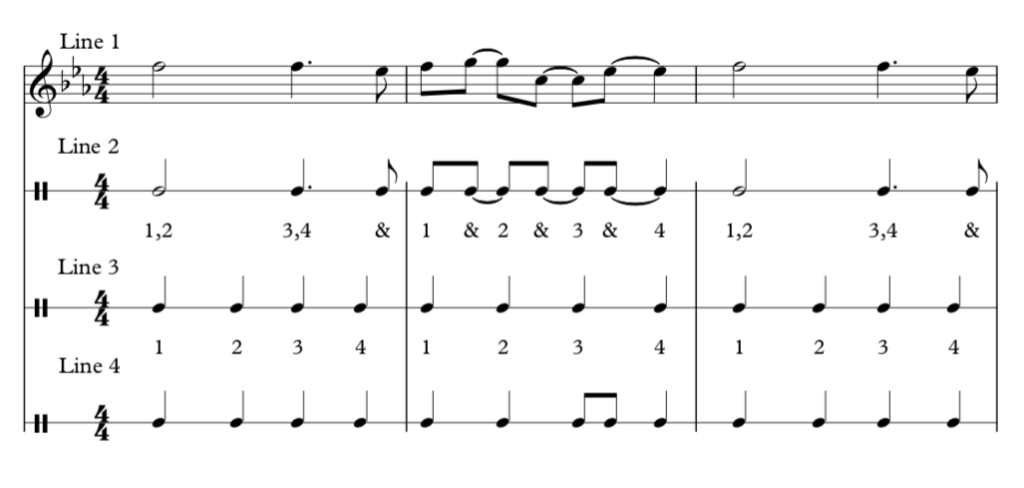
We’ll look at four rhythmic layers side-be-side to see exactly how the beat and melody interact:
- The melody line – the notes you sing or hum
- The rhythmic pattern of the melody – how long each note lasts
- The beats in 4/4 time signature – counting the pulse
- The drum line
Understanding Syncopation, Anticipation, and Delay
Syncopation
Syncopation occurs when a rhythm emphasizes normally weak or off-beat subdivisions. This creates a sense of surprise or tension.
In 4/4 time, instead of stressing beats 1 & 3 (strong beats), syncopation often emphasizes beats 2, 4, or the “&” offbeats.
Anticipation
A note or rhythm sounds just before the beat where it would normally be expected. This creates a forward-pulling motion. It comes early and often ties into the next beat. It is a type of syncopation. A note or chord enters on a weak part of the measure. It resolves on a strong beat. For example, in the song, a note on a beat 4 & that ties into beat 1!
The Time Signature & Beat – Line 3
The time signature of Blinding Lights is 4/4, which means there are four beats in each measure, and each beat is a quarter note long. This is one of the most common time signatures in pop music and is categorized as a simple meter, because each beat can be evenly divided into to parts ( 1 & 2 & 3 & 4 &)
Line 3 should be our starting point. As we listen to, play, or sing the melody, we count each beat – 1,2,3,4 – to stay grounded in the rhythm of the song.
These numbers represent the strong and weak beats in each bar:
- Beat 1 is the strongest (the downbeat),
- Beat 3 is also strong (secondary accent),
- Beats 2 and 4 are weaker, but still important — especially in pop and dance music, where the snare drum often hits on beats 2 and 4.
The Melody – Line 1
After understanding the steady beat in line 3, we move on to line 1, which shows the melody – the actual notes you sing or hum in the song. This line gives us the pitch and shape of the musical phrase.
What’s important here is how the melody relates to the beat. In Blinding Lights, the melody doesn’t always land on the beat – often it comes just after or ties over the beat, which creates rhythmic tension and motion. That’s where syncopation starts to appear.
The Rhythmic Pattern of the Melody – Line 2
Line 2 shows us the rhythm of the melody without the pitches. We remove the notes exact the pitches and focus only on when they happen – their duration and placements against the beat.
This is where we really start to see syncopation in action. In Blinding Lights, many of the notes :
Land off the beat (often on the &s),
Are tied across beats, or
Enter just after a strong beat, making the rhythm feel pushed forward.
Even though the song is in a simple 4/4 meter, the rhythm of the melody adds complexity and drive — it doesn’t sit flatly on beats 1, 2, 3, and 4. Instead, it plays with expectation, creating energy and groove.
This rhythmic layer is essential for understanding why the melody feels exciting, not just what it is.
The Drum Rhythm – Line 4
Line 4 shows the rhythmic pattern of the drums — the backbone of the groove in Blinding Lights. Unlike the melody, which dances around the beat, the drums provide a steady pulse that locks everything in place and follows the beat grid. Only in beat 3, every other bar, instead of xontinuing thw pattern, the rhythm splits into two eighth notes: one eighth on 3 and one in &.
Breaking Down the Intro of Blinding Lights
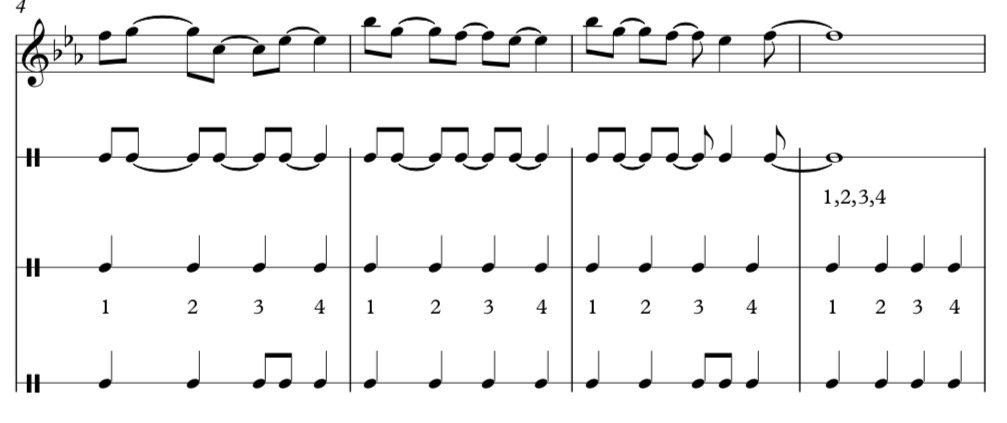
Here’s a 4-line breakdown of the intro of Blinding Lights. We start with the melody, isolate the rhythm, align it with the beat in 4/4, and compare it to the drum rhythm. This helps us visualize how syncopation plays a role right from the start.
Pay close attention to where the melody falls in relation to the beat – especially the tied notes and offbeat entries.
How the Refrain Lifts the Energy – Rhythm Breakdown
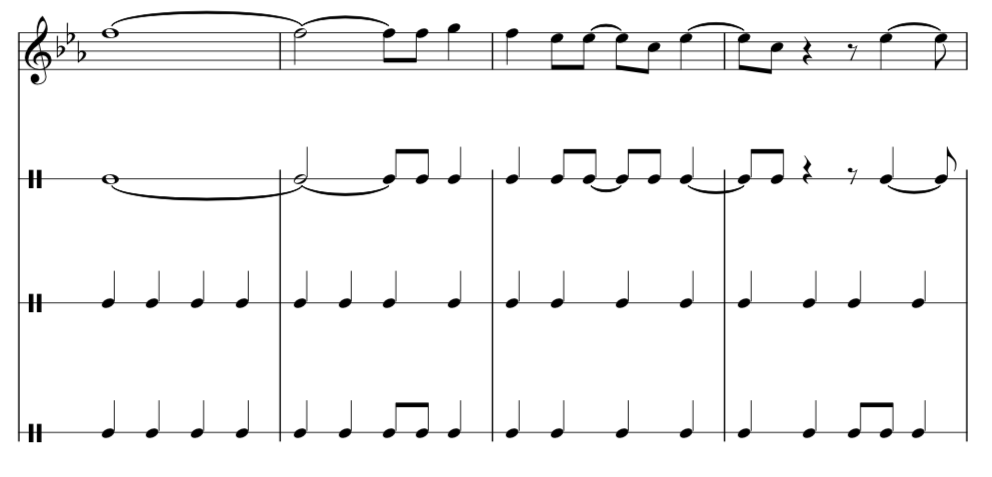
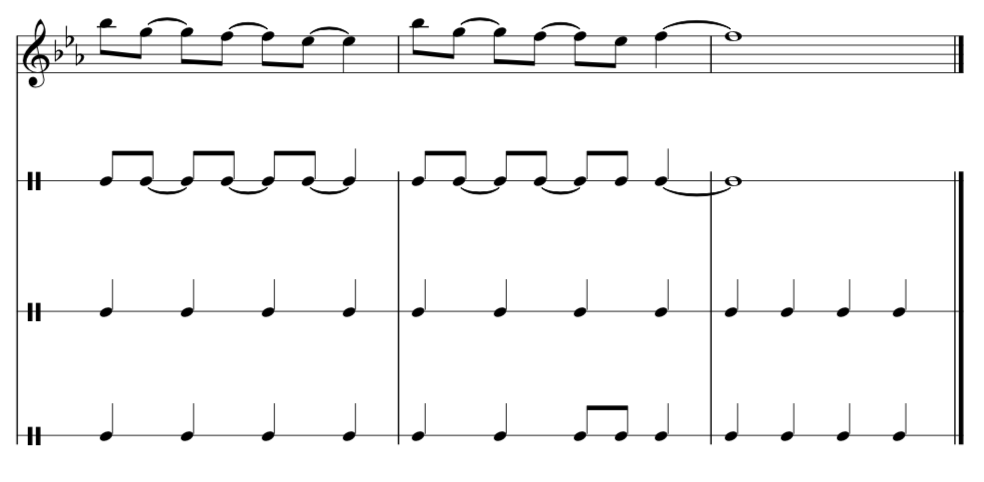
Now we move into the refrain – the part everyone sings along to! Rhythmically, this section builds on everything we’ve seen in the intro, but with even more drive and syncopation.
What This Teaches Us About Syncopation & Simple Meter
By breaking down Blinding Lights into beats, melody, rhythm patterns, and drums, we see how syncopation and simple meter work together to create an irresistible groove.
- Syncopation happens when rhythms play off the main beats, adding excitement and forward motion.
- Simple meter (like 4/4) gives us a steady framework to feel grounded — but it’s the interplay between steady beats and offbeat rhythms that brings music to life.
- Understanding how melody and drums interact helps musicians and listeners feel the pulse better and express music more naturally.
Thy This Syncopation Clap Game!
Put this into practice with a simple clapping game:
- Count out loud: “1 & 2 & 3 & 4 &” while tapping your foot on each beat.
- Clap only on the offbeats (the “&” counts). This mimics the syncopated rhythm found in the melody.
- Add variation: Once comfortable, try clapping the rhythm pattern of the melody (line 2) while still counting the steady beat.
- Feel the groove! Notice how clapping off the beat changes the feel completely — this is syncopation in action.
Comment if you like posts like this!
Tell me which song you want me to analyze next. Gradually, we’ll add harmonic analysis too — so stay tuned!
If you want to support my work and help me post more regular and creative content, check out my
️
Also, find more music theory worksheets about simple meters, syncopation, and more on my
This kind of focused, visual analysis helps us all learn better — thanks for being part of the journey!
Helena