
Jean-Baptiste Burgmüller’s L’Arabesque, Op. 100 No. 2, is one of the most beloved pieces for early intermediate pianists. With its lively tempo, flowing sixteenth notes, and light, playful character, it offers an excellent study in finger dexterity and musical expressiveness. This charming etude is not just a technical exercise—it’s a delightful miniature that captures a sense of elegance and movement, making it a favorite among students and teachers alike.
In this post, we’ll explore the musical and technical aspects of L’Arabesque, offering insights on interpretation, common challenges, and practice tips to help you master this beautiful piece.
The Structure of L’Arabesque: A Classic Example of Rounded Binary Form
Burgmüller’s L’Arabesque is structured in rounded binary form, a common musical design where a piece is divided into two sections, with the first section returning toward the end.
- The A section (measures 2-10/11) introduces a bright, flowing theme that establishes the piece’s playful character.
- The B section (measures 12-19) provides contrast, exploring new harmonies and rhythmic patterns for variety.
- Toward the end of the B section, a recognizable return of the A theme creates a sense of familiarity and closure.
- A’ section 19-27(repeat and till the end)
This return of the opening theme within the second section is what defines rounded binary form, making L’Arabesque a perfect example of this elegant structure.
Harmonic Analysis of L’Arabesque
Burgmüller’s L’Arabesque is in A minor, but it briefly modulates to its relative major key (C major) in the B section, before returning to A minor in the A’ section. This modulation adds contrast and brightness to the piece while maintaining a smooth harmonic connection between sections.
Key Areas and Modulation
- The A section (measures 2–10) firmly establishes A minor, using standard tonic (i) and subdominant (IV) harmonies, along with passing and neighbor chords that enhance the flowing melody.
- In the B section (measures 11–19), the music shifts to C major, with diatonic harmonies reinforcing the new key. However, some chromatic harmonies add tension and interest.
- The A’ section (measures 19–27) brings back the main theme, returning to A minor with slight variations.
Interesting Harmonic Moments
- Measure 14: Secondary Dominant (V7 of A minor)
Despite being in C major, an E major chord (E–G#–B) appears. This is a secondary dominant, specifically V7 of A minor (V7/i), temporarily pulling the harmony toward the home key. Another way to interpret it is as V/VI of C major.- This chord resolves in measure 15 with an A minor chord (i), completing a V–I resolution in A minor, briefly foreshadowing the return of the home key.
- Measure 16: Another Secondary Dominant (V of II in C major / V of D minor)
In this measure, we encounter an A major chord (A–C#–E), which is not diatonic to C major. This functions as:- V of D minor (V/ii in C major), leading to D minor in measure 17.
- Alternatively, it can be seen as V/V (dominant of the dominant in C major), creating a temporary pull toward the dominant area.
- The resolution in measure 17 follows a typical secondary dominant progression, with A major (V of ii) resolving to D minor (ii in C major).
Return to A Minor
After these harmonic shifts, the music settles back into A minor in measure 19, reinforcing the home key. The A’ section mirrors the opening, but the journey through C major and its secondary dominants adds depth and movement to the harmonic landscape.
Final Thoughts
Burgmüller’s L’Arabesque may seem simple at first glance, but its harmonic structure demonstrates classical techniques of modulation, secondary dominants, and smooth key transitions. These elements make the piece not only a great technical study for pianists but also an excellent introduction to functional harmony.
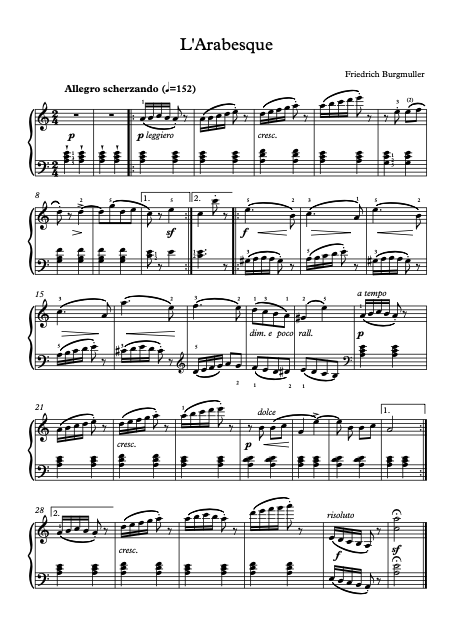
Get the Sheet Music & Harmonic Analysis!
You can find a printable piano sheet of L’Arabesque, so you can practice more freely in my Etsy shop!
Link: https://www.etsy.com/listing/1874773779/burgmuller-larabesque-op-100-no-2-o