
Discover the history of Bach’s Minuet in G Major (BWV Anh.116), explore its harmonic and structural analysis, and download the piano sheet music from my Etsy shop at the end of the post. You can purchase a printable PDF version there!
The History & Importance of Bach’s Minuet in G Major (BWV 116)
Johann Sebastian Bach’s Minuet in G Major (BWV Ahn. 116) is part of the Anna Magdalena Bach Notebook, a collection of keyboard pieces Bach compiled for his second wife, Anna Magdalena, to help with her musical training. This piece was written around 1725. It exemplifies the grace and style of Baroque dance music. Specifically, it highlights the minuet, which was a fashionable courtly dance of the time.
Authorship Debate:
Unlike the Menuet in G Major (BWV Anh. 114), which often mistakenly attributed to Bach, this Minuet in G (BWV Ahn.116) is also listed in the Anhang (appendix) of the Bach- Werke- Verzeichnis (BWV), indicating uncertain authorship. While traditionally attributed to Bach, some scholars suggest it may be by an anonymous composer or a contemporary, as was common in the notebook. Despite the question around the origin, the piece features a more developed melodic and harmonic style. With its approachable key and elegant phrasing, it serves as an excellent learning tool for students exploring Baroque phrasing, ornaments, and form.
The Menuet in G was likely intended as a pedagogical piece. It offered students an opportunity to learn important stylistic elements of the Baroque period. They could engage with a form that was both elegant and accessible. The piece is commonly found in many beginner and intermediate piano repertoire books. Its structure is relatively straightforward. It also has approachable harmonic progressions.
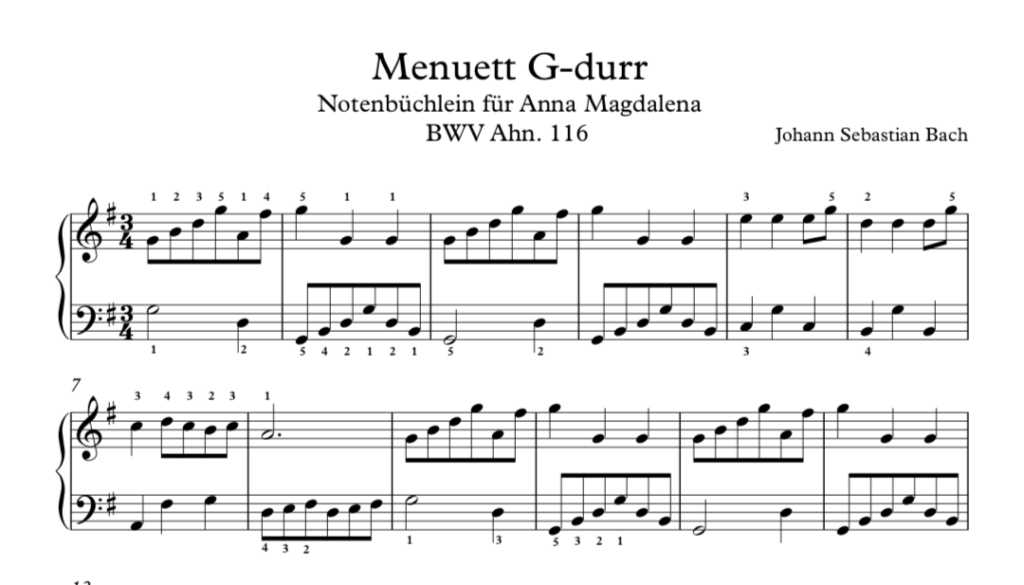
Form & Structure of Bach’s Minuet in G Major (BWV 116):
The first two measures introduce the characteristic Motif of the piece! As you can see, it’s an “arpeggio-like melody” which flows like a musical wave!
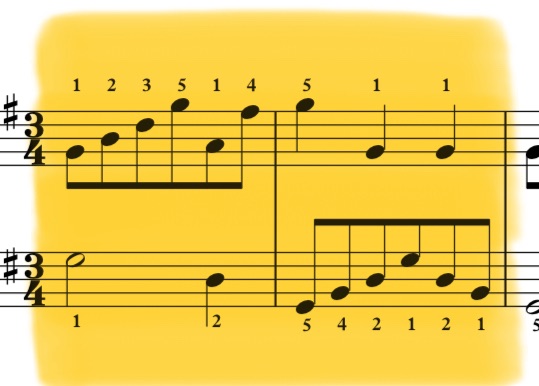
Practice Tip: Before playing the piece, try practicing G Major arpeggios in both clefs to get comfortable with the motion.
The first four measures form the main characteristic phrase of the piece, which is repeated throughout.
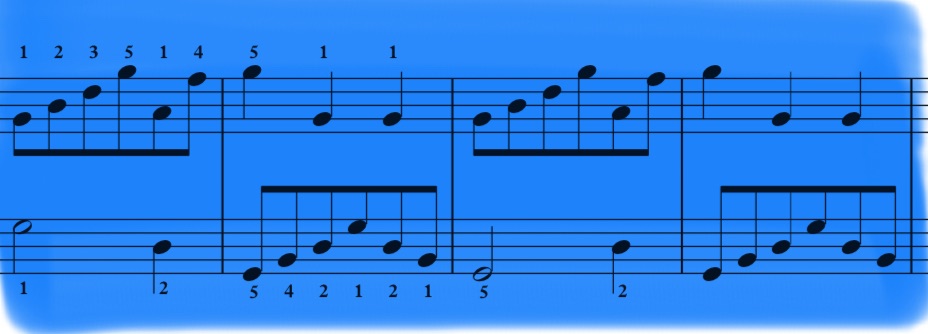
The two phrases together are the whole musical idea of the piece, the Period.
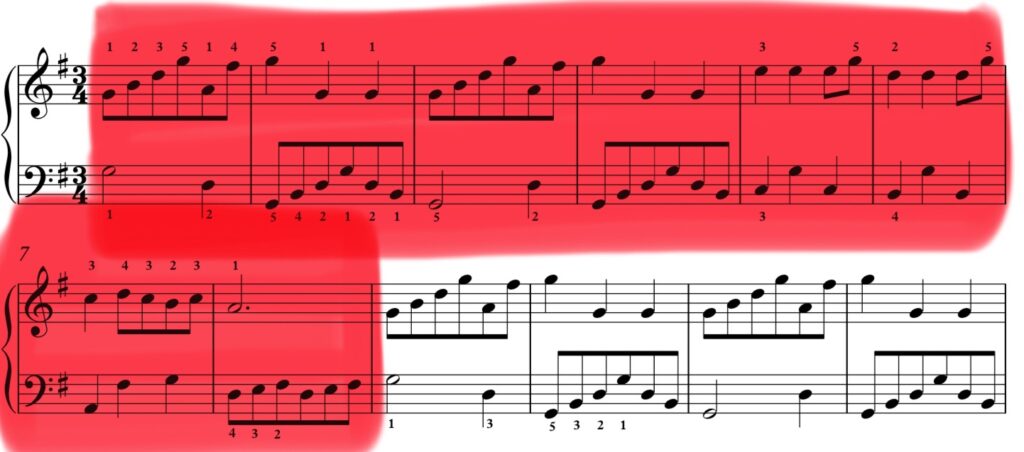
The piece follows a ternary form with internal repetitions:
- Section A (Measures 1-16) – Introduction of the main theme of the minuet, built from lyrical and straightforward melodic lines.
- Section B (Measures 17-32) – This section is made up of two 8-measure phrases and functions as a contrasting middle section.
- Section A’ (Measures 33-40) – We return to the second theme of the Section A (re-introduce the main theme).
Harmonic Analysis
Section A (Measures 1-16)
Key: G Major. Begins with a tonic (I) chord, G Major.
Chord Progressions: We have characteristic patterns of Baroque Harmony, I-IV-V-I, with a stable tonal center which make introduction of harmonic functions more understandable. Measures 7-8, we have a Half Cadence (I-V) and 15-16 a Perfect Cadence (V-I).
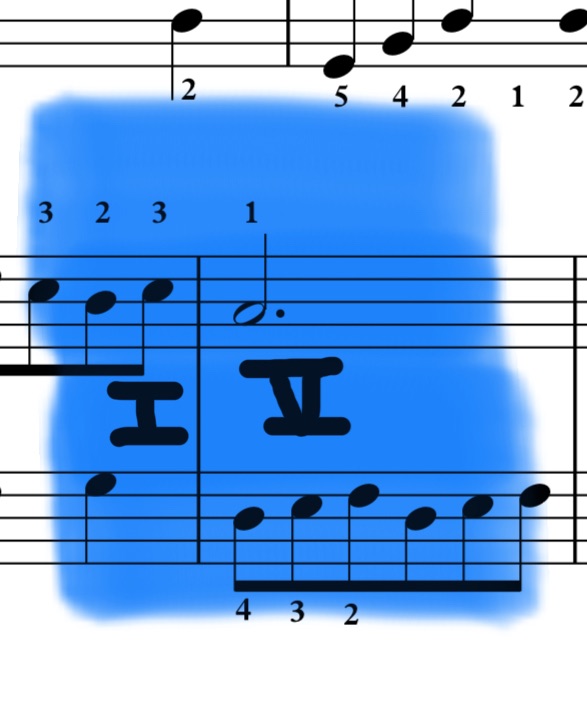
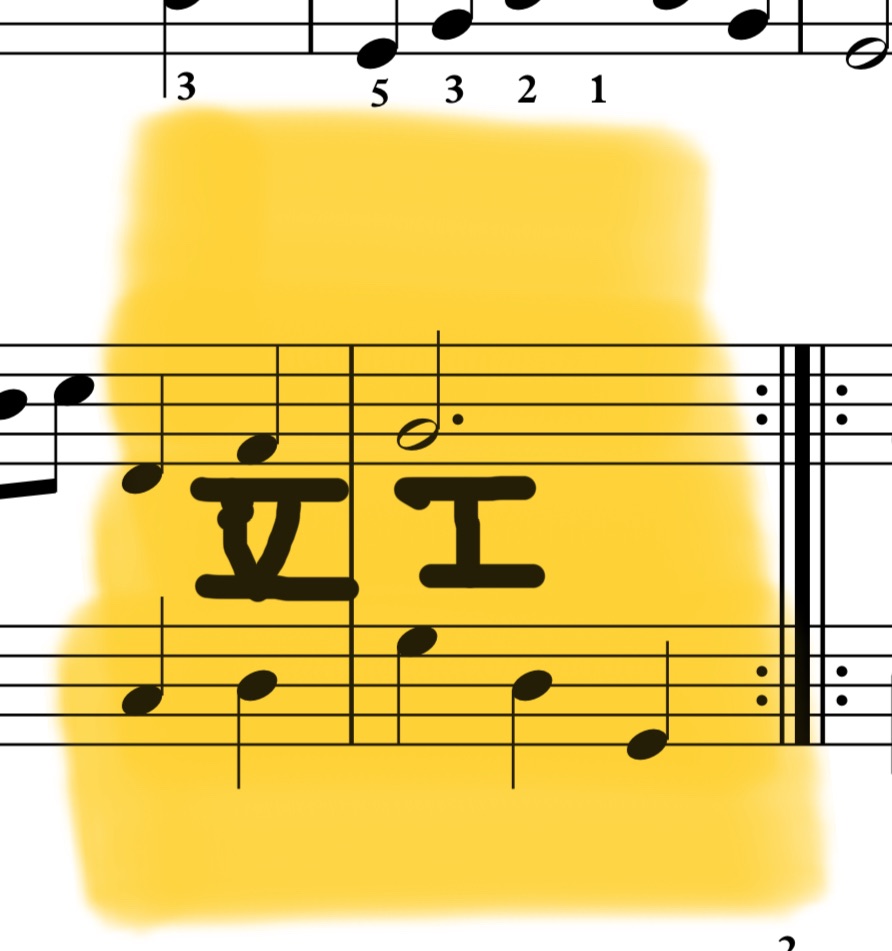
Throughout the piece, one can observe several instances of Ηalf and Perfect cadences, which are essential to understand in order to grasp the structure and flow of Baroque music. This minuet serves as an excellent study tool for developing a deeper awareness of musical phrasing and the cadences that articulate phrase endings.
Section B (Measures 17-32)
Keys:
First Phrase (17–24): Modulates to D major (V of G) or briefly tonicizes E minor (the relative minor of G major). In my opinion, and when I teach this piece I prefer to say that modulates to relative key of G major, E Minor, because of D# in the same measure and the E minor chord in the next measure that can be heard as a clear tonic and establish this modulation. Through the years I’ve heard both D Major and E Minor!
Second Phrase (25–32): Returns firmly to G major, re-establishing the home key.
This section introduces modulation and tonicization, enhancing harmonic variety.Look for secondary dominants and pivot chords—common tools in Baroque modulation that add color and tension, even in pedagogical pieces like this one.These subtleties make the harmony more engaging and provide a learning opportunity for recognizing modulation in context.
Section A’ (Measures 33–40):
Serves as a final resolution, bringing the piece back to the tonic and providing a satisfying sense of closure.
Key: G Major
Reintroduces the first phrase of Section A.
Easy Way to Practice This Piano Piece and Master It!
First, take some time to familiarize yourself with the notes and structure of the piece. I find it really helpful to start every new piece by practicing hands separately. This allows you to master both the melody and the bass line independently and better understand the voice leading and counterpoint style.
Practice slowly and steadily, always maintaining a clear rhythm. Remember—this is a dance in triple meter, so the first beat of each measure should be slightly stronger than the other two. This gives the piece its graceful, flowing dance character!
When you’re ready to put your hands together, focus on one phrase at a time. That’s how I’ve learned even full concertos over the years! Breaking it down into 4-measure phrases helps you internalize the structure. The repeated sections will also help you memorize both the rhythm and the harmony, making it easier to play fluently—or even by heart.
Ready to play the Minuet in G Major (BWV Anh. 116)?
Download high-quality piano sheet music PDF from my Etsy shop and start practicing today!
https://helenapianotheory.etsy.com
Enjoying the content? Want to support my work?
If you find my tutorials and sheet music helpful and want to see more, consider supporting me with a small donation! Your support helps me keep creating educational resources for piano learners around the world.
Buy me a coffee – every little bit helps and means a lot! Just scan the QR code on the side!