
One of the most beautiful pieces of Baroque music! This Sarabande is a part of his Suite in D minor and written for harpsichord (a collection of keyboard works) around 1703-1706 in Hamburg and Italy.
What is a Suite?
“Suite music” refers to a suite, which is a collection of short musical pieces played in succession. These pieces are usually related in theme or style and were historically designed for dance or courtly entertainment.
Suites were especially popular in Baroque music (1600–1750), where composers like Johann Sebastian Bach and George Frideric Handel wrote dance suites, including movements such as:
- Allemande (German origin, moderate tempo)
- Courante (French origin, fast tempo)
- Sarabande (Spanish origin, slow and expressive)
- Gigue (lively, often the final movement)
What is a Sarabande?
Sarabande: is a slow, stately dance in triple meter, originating from Spain in the 16th century before becoming popular in France and later throughout Europe. Early references suggest that the dance had Middle Eastern and Latin American influences, introduced to Spain via trade and exploration. After 17th century, when it was introduced as a French court music, become more slower, with the triple meter (3/4 or 3/2) that gives more expressive and melancholic quality, emphasised second beat.
Handel’s Sarabande after the widespread recognition as a harpsichord piece, adapted for orchestra. Also gained new level of fame in the 20th century from Stanley Kubrick’s Barry Lyndon (1975), he Elephant Man (1980) and Fireworks (1997).
Handel’s Sarabande is more than just a beautiful dance; it’s a powerful expression of emotional depth and dramatic intensity. The piece stands as a remarkable example of Baroque music, showcasing elegance, sorrow, and majesty all in one. With its evocative harmonies, expressive melody, and solemn rhythm, it captures a sense of inevitability and reflection, making it as moving today as it was when first composed. Its ability to resonate across generations, from baroque audiences to modern film scores, solidifies its place as one of Handel’s most iconic works. Sarabande continues to remind us of the timeless connection between music and human emotion.
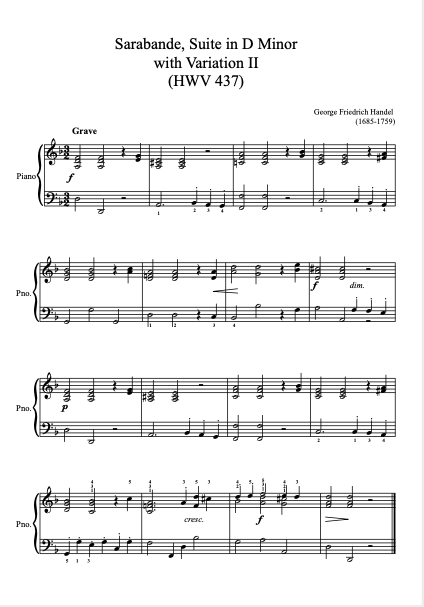
Sarabande’s Theme
Many musicologists agree that while Handel’s version is the most well-known adaptation of this melody, several other composers also used the same theme in their works, further supporting the idea that it predates Handel’s composition. This Sarabande’s melody may have been adapted from a pre-existing folk tune, a common practice among composers of the Baroque era. It was not unusual for composers to incorporate themes from urban folk music into their compositions, reworking them into more refined, structured forms. One of the most beautiful adaption of this theme is Rachmaninoff’s Variations on a Theme of Corelli is based on the La Folia theme. While Handel’s Sarabande maintains a steady, noble character, Rachmaninoff’s variations explore a broader range of emotions, from meditative calm to stormy virtuosity. Yet both works showcase the enduring power of musical transformation, proving that a simple melody can inspire countless interpretations across centuries.