
Melodies and harmonies come from notes working together – and that’s where intervals step in. Last time, we explored semitones and whole tones (half steps-whole steps) as tiny moves between notes. Now let’s see how bigger steps-called intervals- shape the music you hear every day. It’s like measuring the space between notes to unlock tunes and chords!
What are Intervals in Music?
An interval in music is the distance between two notes – How far apart they are in pitch. Understanding intervals is crucial because they are the building blocks of melodies, chords and scales. Every time we move from one note to another, we’re creating an interval.
Why are Intervals important?
Intervals are fundamental in music theory. They help us:
- Build scales: Intervals determine how a scale is constructed (for example, major and minor scales are based on specific interval patterns).
- Form chords: Chords are built by stacking intervals of thirds.
- Create melodies and harmonies: Intervals allow composers and musicians to create musical movement and texture.
In music theory, intervals are named based on two key elements: the number (or size) and the quality. The number represents the counting distance between two notes, determined by including both the starting and ending notes. For example, from C to E is a third (C–D–E), while from G to D is a fifth (G–A–B–C–D). Understanding interval numbers is the first step in identifying musical relationships before adding quality, such as major, minor, or perfect.”
The number of an interval is measured by counting the letter names between two notes, including both the starting and ending notes. (Remember from the Whole Tone & Semitone (Whole Step & Half Step) chapter, the top and the base notes!)
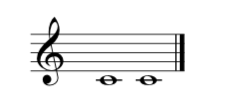
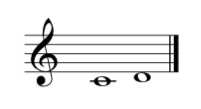
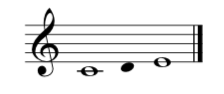
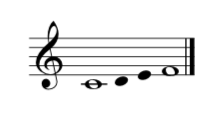
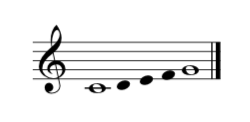
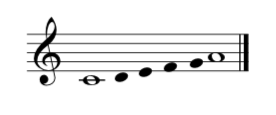
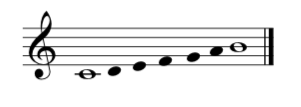
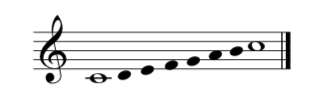
These are the intervals in the C Major scale with the tonic (C) as the reference note. The movement is ascending and melodic, meaning the two notes are played one after the other rather than together. The base note (C) is played first, followed by the higher-pitched note.

These are the intervals in the C Major scale with the tonic (C) as the reference note. The movement is descending and melodic, meaning the two notes are played one after the other rather than together. The higher-pitched note is played first, followed by the lower-pitched base note (C).”

Harmonic intervals in the C Major scale occur when two notes are played at the same time, rather than one after the other (which is called a melodic interval). In a harmonic interval, the two notes sound together, and the distance between them can be described by their number (e.g., second, third, fifth) and quality (e.g., major, minor, perfect).

Support My Work & Enjoy a Coffee!
If you’ve enjoyed learning about intervals, feel free to check out my Etsy shop for more music theory resources, exercises, and materials to help you on your musical journey! Your support means the world, and hey—every purchase helps me grab a coffee for those long study sessions (and maybe a few more interval exercises for you )!
Thanks for reading, and happy practicing!