
Ever played a happy tune and wondered how it works? Welcome to major scales! In this grade 1 lesson, we’ll explore C major scale step by step!
In the previous chapters, we’ve covered whole tones, semitones, and musical intervals. Today, we’re diving into the magical world of scales! In Western music, there are two main types of scales: Major and Minor. (For more information on notation and the history of scales, be sure to check out the Music History category!)
You’ll learn:
- Treble & Bass Clef Notation for each scale
- Ascending & Descending Form
- Arpeggios of a Scale
- Scale Degrees
- Intervals in a Scale
- Tonic Triads
What is a scale?
A scale sequence of musical notes. They are arranged in ascending or descending order. The arrangement is based on a specific pattern of intervals. Scales serve as the foundation of melodies, harmonies, and musical compositions.
In Western music, a scale typically consists of seven unique notes. It is followed by the eighth note, which is the same as the first but one octave higher. The note can be lower in descending order.
There are many different types of scales. The two most common in Western music are Major Scales and Minor Scales. These are determined by the distance and the order of whole tones and semitones between the 8 consecutive notes.
If you want to refresh your musical knowledge about whole tones and semitones, click here.
C Major
Let’s start with the C Major Scale, which is the ‘pattern scale’ for Major scales.
Caution! From now on, the letter “T” under the scale will represent a Whole Tone (or Whole Step).
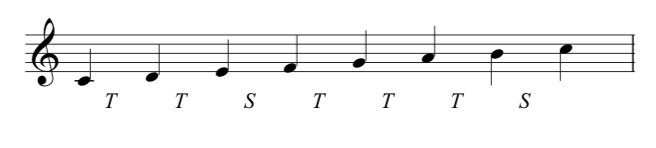
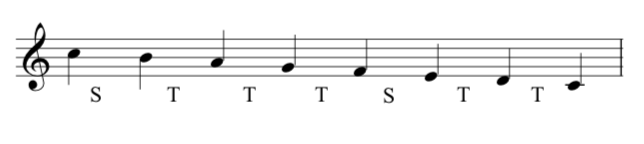
The C Major Scale: Up & Down

The same pattern of C Major Scale on Bass Clef!
Ascending: When a scale is ascending, the notes are played from the lowest to the highest. They move upward in pitch.
Descending: When a scale is descending, the notes are played or written from the highest note. They continue to the lowest note. They move downwards in pitch.


Check how the Tones and Semitones are arranged!
And C Major in whole notes on bass clef.

Scale Degrees
Scale Degree: The position of each note within the scale, relative to the first note (the tonic).
Scale Degrees: Naming Every Note
- Tonic (1st degree) – C
- Supertonic (2nd degree) – D
- Mediant (3rd degree) – E
- Subdominant (4th degree) – F
- Dominant (5th degree) – G
- Submediant (6th degree) – A
- Subtonic (7th degree) – B
- Octave or 8th or Tonic (8th degree) – C (both 3 names are valid!)
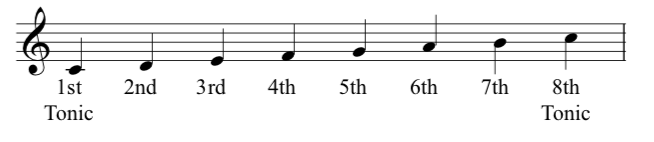
So far, we have explored the C Major scale in both ascending and descending forms, in Treble and Bass Clefs. We have also learned about scale degrees!
For extra practice, it’s a great idea to copy the staves in your music notebook. Then, gradually rewrite them. This will reinforce your learning.
Intervals in Scale
Steps Between Notes
Next, we will study the intervals that are formed between the tonic and the other degrees of each scale. This will help us understand how the tonic chord is built as well as its arpeggio.
In a previous post, you can find a detailed explanation of how intervals are formed as well as their number ( Unison, 2nd etc.) Click here to read the post!

Tonic Triads
Now that we understand intervals within a scale, we can start forming chords—specifically, triads.
A triad is a chord made up of three notes stacked in intervals of a third. These three notes consist of:
- Root – The starting note of the triad.
- Third – An interval of a third above the root.
- Fifth – An interval of a fifth above the root.
The Tonic Triad in C Major
The most fundamental triad in any key is the tonic triad, built on the first scale degree (I).
In C Major, the tonic triad consists of:
- Root: C
- Third: E
- Fifth: G
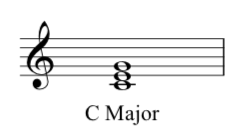
Arpeggios
An arpeggio is the broken chord where the notes of the chord are played one by one! The triad Arpeggio we will study are the notes of the triad chord!
This is the C Major arpeggio. As we can see, it is formed by the root: C, the third: E, the fifth: G, and then the root/tonic of the triad one octave higher: C. The final C can also be considered as the tonic in the 8th octave.


In this post, we’ve covered the essentials of the C Major scale, including how to form them in both treble and bass clef. We’ve also explored the scale degrees, tonic triads, and arpeggios for each scale to help deepen your understanding of their structure and sound.
For more detailed lessons on each individual major scale, check out the separate posts linked below.
G Major:
D Major:
F Major:
If you enjoyed this post and would like more resources, feel free to visit my Etsy shop for additional worksheets. Your support via the Buy Me a Coffee link also helps me continue creating valuable content for musicians like you.
Thank you for your time, and keep practicing—there’s always more to discover in the world of music!