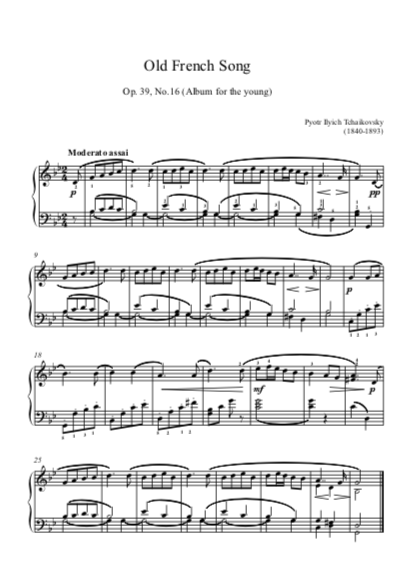
This beautiful piano piece is part of Album for the Young, Op.39, No.16, composed by Pyotr Ilyich Tchaikovsky in 1878. At this time, Tchaikovsky focused on composing works for children, aiming to challenge young pianists while helping them develop their technique and musical expression.
The piece presents a highly expressive and emotional melody, through it remains simple in structure. It consists of two phrases: Measures 1-8, which conclude with a Half Cadence, and a repeat of the first phrase from measures 9-16, ending with a Perfect Cadence. The harmony is straightforward, primarily using Tonic (I) and Subdominant (IV) chords, making it accessible for young pianists.
The second period, spanning measures 17-24, introduces an interesting bass line featuring staccato quavers in an arpeggio style. The harmonic structure remains simple, utilizing tonic (I), subdominant (IV), and dominant (V) chords, creating an accessible yet expressive progression. The piece concludes with a final return to the first phrase, culminating in a Perfect Cadence.
Despite its simplicity, the melody, rhythm and harmonic progression combine to produce a deeply expressive and nostalgic outcome. The dynamics shift from piano (p) to pianissimo (pp) with brief crescendo to mezzo-forte (mf) before the final repetition of the first phrase. This dynamics contrast heightens the tension and emotional depth of the piece.
To perform this work effectively, it must be practised with elegance, capturing the sense of nostalgia and emotional tension inherent in the music. The piece evokes a narrative of human emotion and tenderness, perhaps touching on feelings of loneliness or longing, making it a deeply moving and reflective work for both the performer and the listener.
While Album for the Young was originally intended as a pedagogical collection, Tchaikovsky’s ability to imbue even the simplest of pieces with emotional depth is evident here. This work serves as a beautiful example of his mastery in combining technical simplicity with profound expressiveness, making it a timeless piece for pianists of all ages to explore.