
“Armes Waisenkind” is the sixth piece in Robert’s Schumman’s Album für die Jugend, Op. 68 a collection of 43 short piano pieces composed in 1848 for his three daughters. This melancholic piece in A minor imitates the lament of an orphan and is characterised by its gentle, expressive melody. It is particulary suited for intermediate piano students.
A Touching Story Told Through Music
Schumann believed strongly in music’s ability to tell a story and evoke emotions. Armes Waisenkind (The Poor Orphan) is a perfect example of his gift for musical storytelling, painting a vivid emotional pictures with simple yet powerful musical phrases.
The tempo of the piece is marked Grave, which contributes to its deeply sentimental and emotional character. The dynamics remain predominantly piano (p) throughout, reinforcing the sorrowful atmosphere. Additionally, the use of rallentando ( gradually slowing down ) enhances the expressive weight of the piece. While the composition is primarily in A minor, there are moments of implied modulation to its key, C major, which introduce a bittersweet quality to the overall mood.
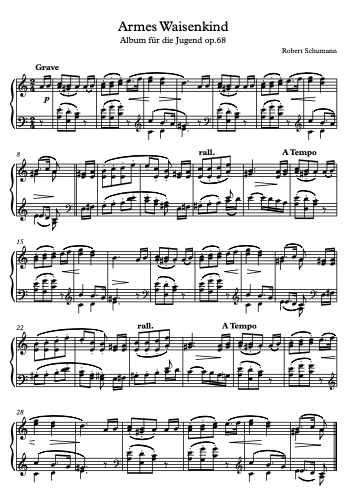
Robert Schumann’s Armes Waisenkind is a masterpiece of simplicity and emotion, capturing the loneliness and tenderness of an orphan’s sorrow. Despite its brevity, the piece carries a depth that resonates with both musicians and listeners, making it a cherished work in the piano repertoire. Whether you are discovering it for the first time or revisiting it, Armes Waisenkind remains a testament to Schumann’s ability to convey profound emotions through music.