Skip to content
Helena Piano & Music Theory
Menu
  • Home
  • Music and Art History
  • Music Theory
  • Piano
  • Printable PDF Worksheets
  • About me
Menu

The C Major Scale in Treble & Bass Clef, Intervals, Tonic Triad, Scale Degrees, and Arpeggio

Posted on March 18, 2025March 18, 2025 by admin

Introduction to the C Major Scale

This post serves as a comprehensive guide to the C Major scale.

For a more detailed explanation of each individual step, including notation and how to position the notes, you can find a separate post that goes into greater depth. You can check it out here!

The C Major Scale is the ‘pattern scale’ for Major scales.

Caution! From now on, the letter “T” under the scale will represent a Whole Tone (or Whole Step).
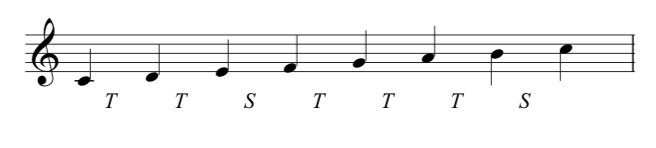

As we learned in the previous chapter on Whole Tones & Semitones (Whole Steps & Half Steps), this is the sequence of a Major Scale.
This is the C Major scale, ascending and descending in whole notes.

The same pattern of C Major Scale on Bass Clef!

C Major scale ascending on the bass clef
C Major scale descending on the bass clef
Check how the Tones and Semitones are arranged!

And C Major in whole notes on bass clef.

C Major ascending and descending
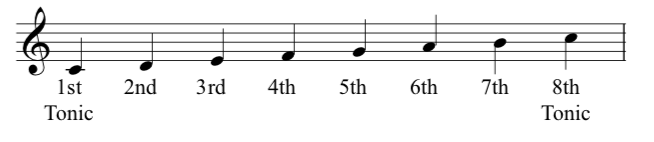
Scale Degrees in C Major
Intervals between the tonic (C) and other degrees of the C Major scale.

This is the C Major arpeggio. As we can see, it is formed by the root: C, the third: E, the fifth: G, and then the root/tonic of the triad one octave higher: C. The final C can also be considered as the tonic in the 8th octave.

C Major Arpeggio in treble clef
C Major Arpeggio in bass clef

As I mentioned in the intro, the full article with a step-by-step formation of the C Major scale, along with a complete theoretical analysis, can be found in the following post:

If you enjoyed this post and would like more resources, feel free to visit my Etsy shop for additional worksheets. Your support via the Buy Me a Coffee link also helps me continue creating valuable content for musicians like you.

Thank you for your time, and keep practicing—there’s always more to discover in the world of music!

Share this:

  • Share on Facebook (Opens in new window) Facebook
  • Share on X (Opens in new window) X

Like this:

Like Loading...

Post navigation

← “The Melancholy Whisper of an Orphan – Schumann’s Armes Waisenkind”
Exploring Beethoven’s Sonatina in G Major →

Recent Posts

  • It’s not just Theory, It’s Etymology!
  • “Avril 14th” by Aphex Twin
  • Chords 101
  • How to Find the Key Signature for Major and Minor Scales
  • Minor Scales


Online Piano Lessons
on Preply
Contemporary & Classical Piano
Music Theory made simple
Learn from anywhere
Get 30% discount for the trial lesson


Archives

Categories

  • Etsy
  • Pinterest
  • X
© 2026 Helena Piano & Music Theory | Powered by Minimalist Blog WordPress Theme
%d