

In this analysis, we will examine the formal and harmonic structure of one of Beethoven’s most well-known sonatinas, the Sonatina in G Major, Ahn. 5, No.1. This is a piano piece for intermediate-level students. Through this analysis, we aim to provide a deeper understanding of the piece, helping to guide the student in both interpretation and performance.
- The sonata is an instrumental musical work that developed in the 17th century. The sonatina is a shorter and simpler form of the sonata. It usually consists of two or three movements. The first movement follows a small sonata form, with a limited length, possibly a single main theme, and a basic development. The middle movement is based on simple Lied-type musical forms, while the final movement is usually in rondo or sonata form.
- The first movement of a sonata or sonatina is usually defined by the presence of two or more themes. The standard approach emphasises the harmonic and thematic organisation of tonal material, which is initially introduced in the exposition (First Section), then developed and contrasted in the development (Second Section), and finally resolved both harmonically and thematically in the recapitulation (Third Section).
How to practise sonatina
This is an excellent piece for students to become familiar with Alberti bass, as well as with phrases that require legato playing. In the edition I have worked on and analyze in this pose there are also staccato notes and pedal markings.
First, the student should practice each hand separately, In the right hand, we should focus particularly on the legato phrasing of the melody. Beginning with a slow tempo, they should gradually combine both hands while maintaining a steady beat. With the gradual introduction of the pedal, they will progressively prepare to play the piece in a complete form! But this is a little bit later!
This Sonatina is a characteristic piano piece of the Classical Era. The left hand has the classic Alberti bass, and in general, harmony speaking, there is a lack of modulation and many scale-like passages, feels like an Hanon exercise. In a way, maybe it is! The piece was likely composed for one of Beethoven’s students – or perhaps even by one of them! It has a very clear structure and a simple harmonic progression. This Sonatina was found among Beethoven’s papers after his passing in 1827.
First Movement
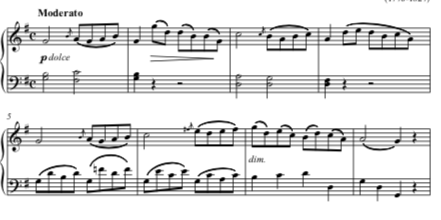
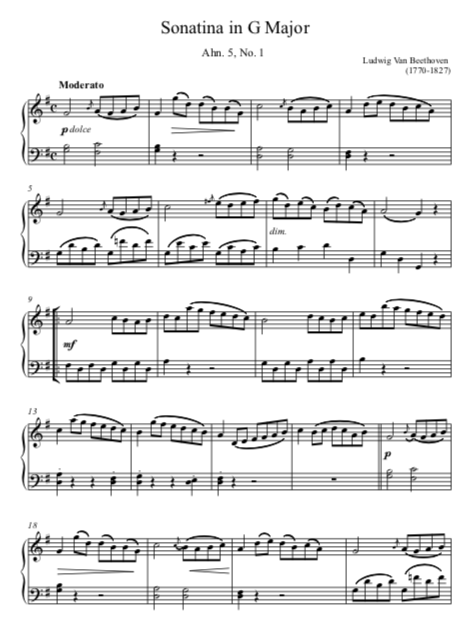
The first movement follows a ternary form with A for the exposition, B for the development, A for the recapitulation, and a coda. In the first section, the exposition spans measures 1 to 8. It is a symmetrical period consisting of two phrases: the first, from measures 1 to 4, ends with a half cadence, while the second, from measures 5 to 8, resolves with a perfect cadence (final descent). In the exposition of the Sonatina, from measures 1 to 8, the music consists of two phrases, during which the characteristic motifs of the composition, such as the Alberti bass, are introduced. The entire section is written in G Major.
In the development of the Sonatina, from measures 9 to 16, we see the treatment of the main theme. The modifications appear mainly through the augmentation of motifs as scale-like passages, and the entire section is in G Major.
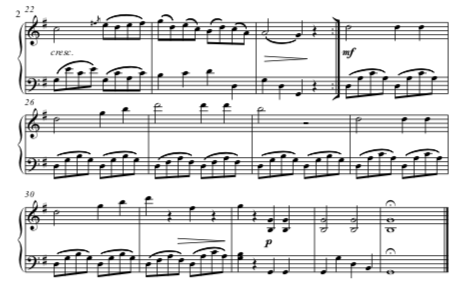
In the recapitulation of section A, there is a full repetition of the first section of the Sonatina in G Major. The final part is the coda, which provides a sense of closure to the piece. The Alberti bass is the dominant feature in the left hand, while the melody is very simple, with a sense of a rhythmic motif that recalls the main motif of the Sonatina. The piece concludes with a perfect cadence.
Exposition (A): Measures 1-8 ( Two phrases in G Major. 1st phrase (1-4) ends with Half Cadence, 2nd phrase (5-8) resolves with Perfect Cadence.
Development (B): Measures 9-16
Recapitulation (A): Measures 17-24
Coda: Measures 25-34
Second Movement- Romanze
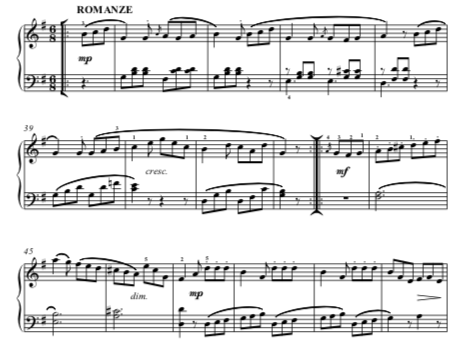
Romance is a lyrical piece, with a tempo and a completely different structure. It is written in 6/8 time, (compound meter) featuring a different bass pattern and open chords that accompany the melody. Despite these differences, it still follows a sonata form, like the rest of the composition, with exposition (A), development (B), recapitulation (A), and coda.
The exposition runs from the beginning until measure 8, where the repeat occurs. It is particularly interesting for a piece of this level, as there is a tendency for modulation from the G Major (the key the piece is written in) to D Major (dominant of G Major), and also a shift towards C Major (the fourth of G Major, with C Major being its dominant).
These modulatory movements are quite common, allowing the student to become familiar with the concept of modulation in a very accessible way, both on a harmonic and aural level.
In the development (B), the theme is revisited, mainly based on rhythmic motifs. We also encounter scales in the melody, reminiscent of the development in the first part of the Sonatina. Harmonically, there is a complete modulation to D Major.
From measures 17 to 21, there is a small “bridge” with arpeggios in the bass chords and a “melodic tail”, which leads us back to the first theme, and guiding us to the recapitulation. The last 12 measures form the coda, which is again based on rhythmic motifs that have been developed to provide a sense of completion to the composition.
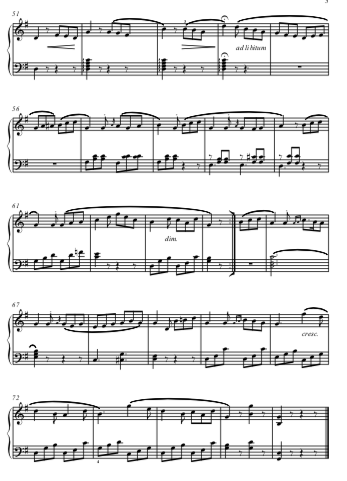
This Beethoven’s Sonatina it’s shorter in length (and sonatina as a form in general!) compared to his other major works, especially the famous Sonatas, but has a rich in musical depth and offers invaluable insights into his compositional style. Studying this piece is very important for a student, as it provides a first introduction to and understanding of sonata form. It contains the fundamental and most important musical characteristics of the Classical period and combines rich harmony with relatively simple technical demands.
If you’re interested in learning or performing this piece, you can find the piano sheet music for Beethoven’s Sonatina available in my Etsy Shop: https://helenapianotheory.etsy.com
If you enjoy my content and would like to support my work, consider buying me a coffee . Your support helps me continue creating more valuable resources for musicians like you.
Thank you for reading, and I hope this analysis has sparked your curiosity to explore more of Beethoven’s remarkable music!