
Slurs vs. Ties in Music: What’s the Difference?
Slurs and ties look almost identical, but they play very different roles in music notation. In this post, you’ll learn the difference between slurs vs. ties in music, why they matter, and how they affect performance and rhythm. Understanding how to read and write slurs and ties in music will improve your phrasing articulation, and rhythmic accuracy.
What Is a Slur?
A slur is a curved line that connects two or more notes of different pitch. It tells the musician to play the notes smoothly and connected. This technique called legato. Slurs affect the articulation of the music – how it sounds – but not the duration of each note. In short, slurs change how music is played, not how long it is played.
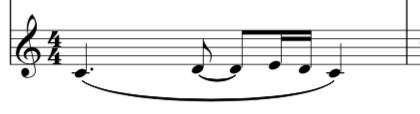
Additionally, slurs help group notes into musical phrases. They give the melody shape and direction. Whether you’re paying classical or modern music, using slurs correctly enhances expression and musical style.

What Is a Tie?
A tie is also a curved line, but it connects two notes of the same pitch. Instead of paying the note twice, you hold the first note for total value of both notes combined.
For example: A quarter note tied to an eight note means you hold the note for 1 + ½ = 1½ beats.

Ties are often used to :
- Extend a note across a beat or bar line
- Maintain clear rhythmic grouping in notation
- Show durations that don’t fit a single note value
When used correctly, ties improve both readability and timing in written music.
Why Proper Notation Matters?
When writing music, it’s important to show that beat clearly. Music is organized in measures (bars). and each beat has a natural strength, a level of importance. For example, in a 4/4 time:
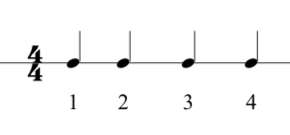
- Beat 1: Strong
- Beat 3: Secondary Strong
- Beats 2 and 4: Weak
Important: Long notes like minims (half notes) or semibreves (whole notes) should start on downbeats. If a long note starts on a weak beat and continue over a strong beat, use a tie. This keeps the beat structure visible, which helps with phrasing and interpretation.

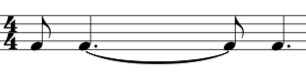
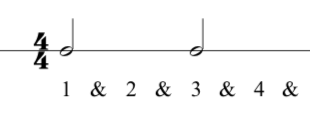
When writing music, clear use of ties helps show long a note extends across beats. This is especially useful when working with syncopates rhythms or complex phrasing.
The Role of Ties in Notation Clarity
Ties aren’t just about holding notes longer – they help organize rhythm clearly across beats.
When a note crosses over from beat 2 to beat 3, it’s better to write it as two notes tied rather than one long note.

When you write rhythms, it’s best practice to start longer note values on downbeats.
In the picture below, we see measures with rhythmic patterns. The top line shows the correct way to notate some of these patterns using ties, which makes it much easier to keep track of the beats and count each measure accurately. The bottom line shows incorrect notations, where it’s more difficult to interpret the note values without ties. It can be pretty frustrating, can’t it?!
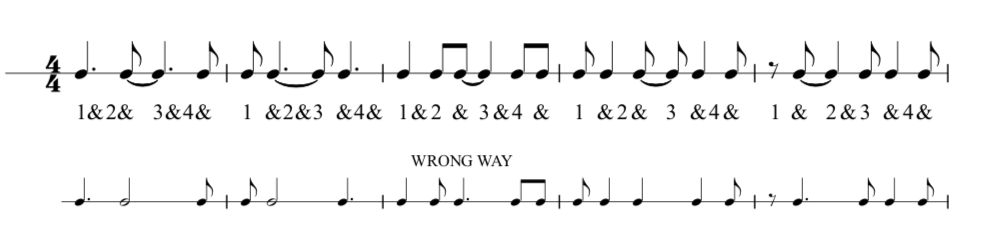
For example, a minim (2 beats) should usually start in a strong beat. If it doesn’t, break it into tied smaller values (like a quarter) so the rhythm matches the beat structure clearly. This helps performers read and feel the pulse more easily, and it improves rhythmic accuracy and musical phrasing.

Downbeats and Upbeats

A downbeat is the first and strongest beat of the measure.
Time Signature Examples:
So, In 4/4 time, we count: 1 & 2 & 3 & 4 &

- 1, 2, 3, 4 = downbeats (on the pulse)
- Each & (“and”) = upbeats (in between pulses)
In 3/4 time, we count: 1 & 2 & 3 &
- Same idea: numbers are downbeats, “&”s are upbeats
In 6/8 time, beats are grouped in two main beats

- Count: 1 & & 2 & &
- 1 and 2 = main beats (downbeats),
- The “&”s are upbeats or subdivisions
Tip: Understanding downbeats and upbeats is key when working with ties and syncopation, especially when writing rhythms that cross beats.
Ties and Syncopation
Ties are essential when writing syncopation – rhythms that emphazise unexpected or offbeat moments. They shift the natural accent away from strong beats, creating tension, groove, or surprise.
By using proper ties, composers and arrangers can:
- Highlight offbeats
- Make complex rhythms easier to read and count
- Preserve the structure of the meter
Without ties, syncopated rhythms can look confusing and be hard to count or perform accurately.
Wrap-Up
Understanding slurs and ties in music is essential for writing and performing with clarity. Slurs affect how notes are played; ties affect how long they are held. Both tools help musicians interpret music more accurately.
When you notate music clearly, you make it easier to read, count, and perform – which leads to better playing and a stronger musical experience overall.
To wrap things up, this post covered three topics: ties, slurs, and a brief introduction to syncopation. I know -it might feel like TMI (to much info :D)! But don’t worry -the goal here is simply to get familiar with the basic terminology, see some helpful examples, and start recognizing how these elements make reading, practicing, and even listening to music easier and more enjoyable!
If you’re like more practice, you can check out my worksheet on rhythmic patterns, proper notation with ties, and much more -available on Etsy and Buy Me a Coffee!
Join the Weekly “Melody Hub”
Want to learn or refresh your music theory skills at your own pace?
Every Sunday, you’ll get a printable PDF lesson + extra worksheet straight to your inbox!
- Perfect for beginners & self-taught musicians
- Easy-to-follow printable PDFs
Subscribe for €7/month on Buy Me a Coffee, and you’ll receive a new PDF lesson every week!
Your support not only gives you great resources but also helps me keep creating -so thank you, it truly means a lot!
Looking for more?
Check out my Etsy shop for additional worksheets and piano sheet music!
Happy Practicing! – Helena