
Syncopation changes the way rhythm feels by shifting the accents. But what is syncopation in music exactly? It’s when a rhythm emphasizes weak beats or offbeats instead of the natural strong beats. This adds surprise, groove, and energy.
Learning what is syncopation in music helps understand modern rhythm and how to write or play music with better expression.
Understanding Beat Structure
In most time signatures, some beats are strong and some are weak. For example, in a regular 4/4 time:
- Beat 1: Strong
- Beat 2: Weak
- Beat 3: Secondary Strong
- Beat 4: Weak
*Weak beats or Backbeats.
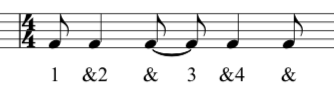
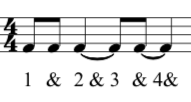
Syncopation often shifts the accent to those weaker or unexpected moments, making music feel lively or “off the beat.”
Syncopation plays with these expectations.
Types of Syncopation
- Suspension Syncopation
- A note starts on a weak beat and is tied across a strong beat.
You expect a strong beat, but it’s replaced by a continuation of previous note
- A note starts on a weak beat and is tied across a strong beat.
- Missed Beat Syncopation

- A rest appears on a strong beat, creating space and tension.
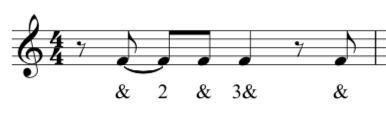
- A rest appears on a strong beat, creating space and tension.
- Even Note/ Backbeat Syncopation
- Emphasis on beats 2 and 4 instead of 1 and 3.
- Very common in pop, jazz, and rock.

- The back beat gives a groove its reference point and helps anchor the rhythm.
- Emphasis on beats 2 and 4 instead of 1 and 3.
- Offbeat Syncopation
- Accents fall on “&” , between the beats
- Can occur on the beat level (shifting stress to an upbeat)
- Or on the division level (sixteenth notes or smaller), adding rhythmic complexity
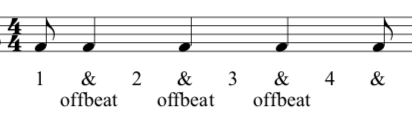
- Accents fall on “&” , between the beats
Why use Syncopation?
- It creates movement and contrast
- It makes rhythm move interesting
- It add groove and character
Syncopation emphasizes offbeats or weak beats, disrupting expected rhythmic patterns not only with ties but with rests, or subdivided beats (or short notes) to shift emphasis between beats.
Wrap Up
If you’re asking “what is syncopation in music?” – it’s the heartbeat of groove. It adds life to rhythms and helps your music feel more expressive.
Looking for more?
Check out my Etsy shop for additional worksheets and piano sheet music!
Happy Practicing! – Helena