
Beaming Notes in Music: A Guide to Rhythmic Clarity
When we talk about beaming notes in music, we’re talking about how to group notes like quavers (eights notes) and semiquaver (sixteenths notes). These notes have flags (or called tails) attached to their stems. When these notes come together in groups, we don’t draw each flag. Instead, we join their tails to create a straight line – that’s called a beam.
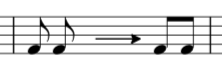
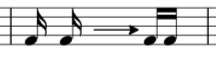
Why is beaming important? Beaming notes in music helps us see the beats more clearly in a bar (measure). This makes music much easier to read, especially when we’re dealing with fast notes.
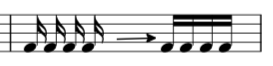
How Beaming Works
Quavers (eighth notes) have one tail, so when they are joined together, to get one beam. Semiquavers (sixteenth notes) get two beams and so on! So beams are lines that connects the flags of notes. Each beam replaces the individual tails these notes would normally have. We join then together with beams to show they belong to the same beat or rhythmic group.
Beaming Notes and Time Signature
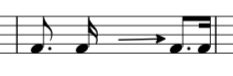
Beaming is not just decoration – it is based on the time signature. Time signatures shows how the beats are divided in a measure. Beaming is always related to the main beat of each measure. And only within that measure. This means we can’t group beamed notes across bar lines. In each measure (or bar), some beats get more emphases that others, creating the natural pulse of music.
Another important rule: we can’t start a beamed group of notes on an offbeat. For example, let’s say we want to place a quaver (eight note) on the “&” after the beat 2, and then two more in beat 3 and 4. The note that starts on the “&” should stand alone with its own flag, while the ones that fall on the beat can be beamed together as usual.
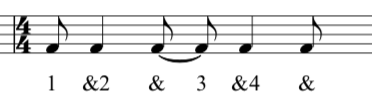
There’s an exception to this: if there’s a rest or a dotted note before the off beat, then special grouping might apply – but the goal is always to keep the beat cleat and easy to read.
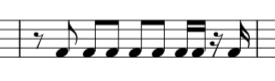
In addition, we can group two notes with tails and a rest between them. Rest, even if they have their “tails”, rests can’t be beamed together!
Beaming Notes Rules
- Don’t beam across bar lines
- Don’t start beams on offbeats
- If a note lands on “&” (an offbeat), it often stands alone
- Rests can go between beamed notes but are never beamed
- Beam directions depend on stem direction and pitch placement
Beaming Notes in Different Time Signature
2/4 Time

In 2/4 time, we have two main crotchet (quarter note) beats per measure. The first beat is the strong beat, and the second is the weak (less emphasised) beat. In the first measure, we see a group of quavers (eighth notes) beamed together on the second beat. As you can see, all the previous rules about beaming notes per beat are applied. This helps make each beat clear and easy to read.
3/4 Time

Here, in a 3/4 time signature, there are three main crotchet (quarter note) beats per measure. The first beat is the strong one, and 2 and 3 beats are weak. The quavers (eighth notes) are beamed in pair because that’s the first level of beat subdivision, making the rhythm easier to see and count.
In the fifth measure, we see syncopation. In the last measure, based on the first level of subdivision, the first beat is counted as “1 e &”. The second beat starts with a rest, and the “&” is a quaver – but it’s not beamed together with the two quavers that follow. Why? Because of a basic rule: we must follow the beat pattern of the time signature. Notes that don’t belong to the same beat aren’t beamed together. Simple as that!
4/4 Time

In the 4/4 time signature, there are four beats crotchet (quarter note) beats per measure. Again, we see the important rule: group beamed notes within each beat. Don’t beam across beats, like between 2 and 3, unless the rhythm flows naturally and it’s clearly readable.
In the first measure, you might see four pairs of two quavers (eighth notes) grouped in twos – and that’s perfectly correct. Both that and other clear groupings can be used, as long as the beat is easy to see.
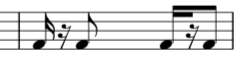
Furthermore, pay attention to the rests and how they affect beat subdivision. You’ll notice that some notes with tails are left single and not grouped with others – and that’s because they don’t faill within the same beat pr the grouping would confuse the rhythm.
So, why Beaming Notes in Music Matters ?
- Easier to read
- Shows beat groupings
- Reflects rhythm clearly
- Helps with tempo and timing
Love these advanced theory worksheets? Donate to keep weekly free PDFs and posts coming:
Buy Me a Coffee
Your support not only gives you great resources but also helps me keep creating -so thank you, it truly means a lot!
Looking for more?
Check out my Etsy shop for additional worksheets and piano sheet music!
Happy Practicing! – Helena