
Key signatures inform the performer about the scale and key in which a piece of music is written. They are a set or series of sharps or flats and they appear at the beginning of a musical staff, right after the time signature. Each key signature defines a specific tonality and indicates which notes stay raised or lowered throughout the piece. The notes of a scale can appear in any octave -high or low- while keeping the same tonal relationship. Understanding key signatures with the guidance of Circle of Fifths is essential for reading, interpreting, and performing music accurately.
Recognizing Key Signatures in Music
Recognising the key signature is essential for every musician.
Before you start, make sure you are familiar with the symbols for sharps (#) and flats (♭).
You can learn more about sharps, flats, and accidentals in this detailed post for a deeper understanding of how they work in music theory.
The Order of Sharps (#) & Flats (♭)
The order in which sharps and flats appear is not random—this sequence is called the key signature. Sharps and flats always follow a specific order:
The Order of Sharps
- F#, C#, G#, D#, A#, E#, B#
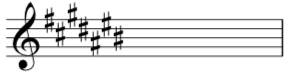
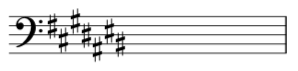
The Order of Flats
- Flats: Bb, Eb, Ab, Db, Gb, Cb, Fb
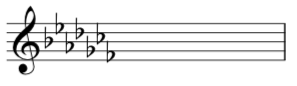
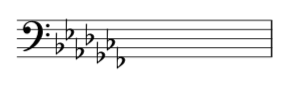
It is important to memorize these sequences thoroughly, as they form the foundation for reading and understanding any key signature.
Once you practice with the two simple “patterns”, you will be able to identify the key signature of any scale quickly and accurately.
How to Identify Sharp Key Signatures
For a sharp key signature in a major scale, the key name is always one semitone (half-step) above the last sharp. For example, if a piece begins with F#, move up one semitone to G. This means that the F# belongs to the G major scale.

Applying the Rule to Multiple Sharps
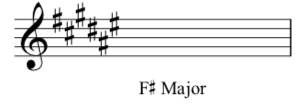
The same rule works for multiple sharps. For example, in a key signature with F#, C#, G#, D#, A#, E#, the same rule applies: the key of the scale is one semitone above the last sharp. For instance, if the last sharp is E#, move up one semitone to F, so this key signature belongs to F# major.
Understanding this rule allows you to quickly identify the major scale associated with any sharp key signature and read music accurately.
At this point, if you have any questions about whole tones and semitones, you can check out comprehensive post on the theory of tones, semitones, enharmonic equivalents, and key relationships for a detailed explanation.
If you have any questions or want to refresh your knowledge of intervals, you can check out comprehensive post on intervals on the site. Each interval is explained clearly with examples to make learning easier!
It is important to practice key signatures from both major and minor scales regularly, as they appear in every piece of music we study and perform.
Let’s go through the scales one by one, examine their key signatures, and analyze the circle of fifths to make it easier to understand and apply.
Major Scales – Sharp Key Signatures
- C Major – no sharps
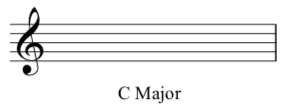
- G Major – 1 sharp
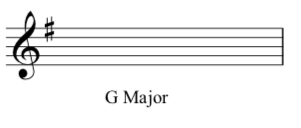
- D Major – 2 sharps
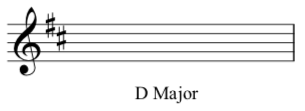
- A Major – 3 sharps
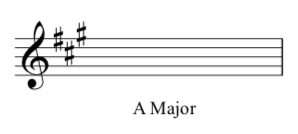
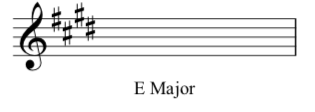
- E Major – 4 sharps
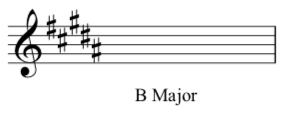
- B Major – 5 sharps
- F# Major – 6 sharps
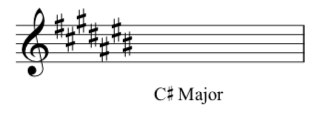
- C# Major – 7 sharps
Observations for Sharp Key Signatures
From the sequence of major scales, we can make several observations:
- Each scale in the sequence is a perfect fifth above the previous one. For example, starting from C major, the next scale is G major (G is the fifth of C), and then D major (D is the fifth of G), and so on.
- Each new scale adds one sharp, following the order of sharps.
- The last sharp in the key signature is the leading tone of the scale. It resolves to the tonic (the keynote) of the scale.

Example – B Major
- To find the key signature for B major:
- move one semitone down from the tonic (B → A#)
- List the sharps up to this note in the order of sharps: F#, C#, G#, D#, A#.
- This is the key signature of B major. Notice that A# is the seventh degree of the scale, resolving to the tonic B.
To find the next scale in the series, move to the fifth of B major, which is F# major. This scale contains all the sharps from B major, plus one additional sharp (E#).
Major Scales – Flat Key Signatures
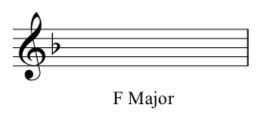
- F Major – 1 flat
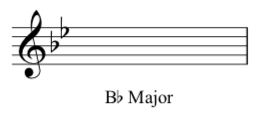
- Bb Major – 2 flats
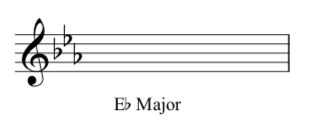
- Eb Major – 3 flats
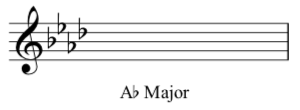
- Ab Major – 4 flats
- Db Major – 5 flats
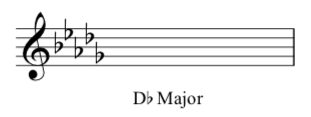
- Gb Major – 6 flats
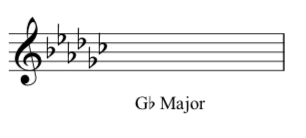
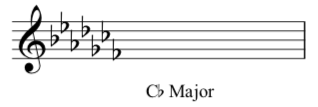
- Cb Major – 7 flats
Observations for Flat Key Signatures
- In flat key signatures, each subsequent scale is a perfect fourth above the previous one. For example, starting from Bb major, the next is Eb major (Eb is the fourth of Bb).

- Alternatively, this can be seen as a descending perfect fifth.
- Each new scale includes the key signature of the previous scale, plus one additional flat following the order of flats.
- The last flat in the key signature is the fourth degree of the scale.
Example – Ab Major
To find the key signature of Ab major:
- List flats up to the fourth degree of the scale, plus one additional flat.
- For Ab major: Bb, Eb, Ab, Db.
- Notice that Db is the fourth degree of the Ab major scale.
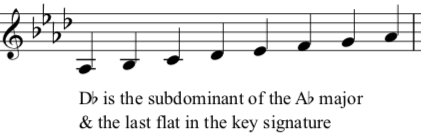
To find the next scale, move to the fourth degree of the current scale, which gives Db major. Its key signature contains all the flats from Ab major, plus one more (Gb).
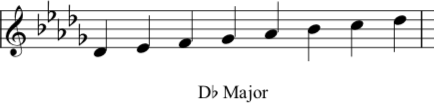
This concludes our overview of major scales with sharps and flats. We have examined how to recognize key signatures, the order of sharps and flats, and practical examples of major scales.
In the next post, we will explore enharmonic scales, understand theoretical major scales, and dive deeper into the Circle of Fifths. This will help you fully grasp how key signatures connect across all scales.
If you found this post helpful and want to support more lessons like this, consider making a small donation via Buy Me a Coffee. Your support allows me to continue creating educational content, lessons, and practice materials for musicians of all levels.
You can also find exercises for key signatures and scales in my Etsy shop.