
Understanding half steps and whole steps is essential for mastering music theory, as they form the foundation of scales, intervals, and harmony. These small yet crucial steps between notes define the structure of melodies and chords, shaping the way music sounds and feels. In this guide, we’ll explore the difference between half steps and whole…
Category: Music Theory
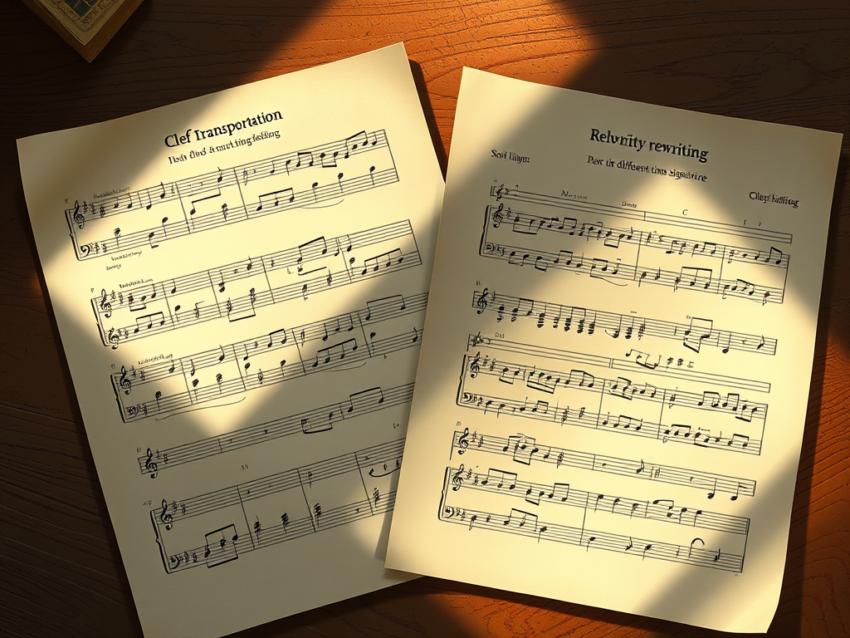
Grade 2 Music Theory: Download PDF Exercises for Clef Transposition & Rewriting a Melody
Here you can instantly download two free printable PDF exercises. They are designed specifically for practicing Clef Transposition and they also focus on the essential skill of rewriting a melody in a different time signature! These resources will greatly enhance your musical abilities and understanding. Discover more in-depth information about the process of rewriting a…
4.b. Pitch & Transpose: A Melody Across Clefs
Mastering Melody Transposition Between Treble & Bass Clefs While Maintaining Pitch Pitch is a fundamental element of sound. It plays a crucial role in music when organized within a musical context, as we discussed in an earlier post. It is a perception of how high or low a note sounds. This perception is determined by…
Chapter 1: Introduction to Musical Intervals
Melodies and harmonies come from notes working together and that’s where intervals step in. Last time, we explored semitones and whole tones (half steps-whole steps) as tiny moves between two notes. Now let’s see how bigger steps, called intervals, shape the music you hear every day. It’s like measuring the space between notes to unlock…
8.c. A Major Basics – Scales, Arpeggios and Triads for Grade 2
Another major we will study is the A Major scale. A Major starts from the note A and write the notes in order, up to A an octave higher. First, we notice that E-F interval is a natural semitone. To form the major scale, we observe that the interval C-D is a tone, but for the major…
8.b. D Major Basics – Scales, Arpeggios and Triads for Grade 1
The third major we will study is the D Major scale. Just like G Major scale we studied earlier in this post, we start from the note D and write the notes in order, up to D an octave higher. First, we notice that E-F interval is a natural semitone. To form the major scale,…
8.c. F Major Basics – Scales, Arpeggios, and Triads for Grade 1
F Major Like the previous scales (G & D) we’ll study and “build” the F Major! We start by writing the first note, the tonic F. Then, we continue writing the notes step by step. Our aim is to reach the F one octave higher! To make this scale sound major, we apply the Tone-Semitone…
8.a. G Major Basics- Scales, Arpeggios, and Triads for Grade 1
G Major Mastered C Major? Now we will move on to the G Major Scale! The first note of the scale, which is the tonic degree, is G. As we write the notes in sequence until we reach the next G an octave higher, we form intervals of whole tones and semitones, making this scale…
The G Major Scale in Treble & Bass Clef, Intervals, Tonic Triad, Scale Degrees, and Arpeggio
Introduction to the G Major Scale This post serves as a comprehensive guide to the G Major scale. For a more detailed explanation of each individual step, including notation and how to position the notes, you can find a separate post that goes into greater depth. You can check it out here! But what is a F#?…
The C Major Scale in Treble & Bass Clef, Intervals, Tonic Triad, Scale Degrees, and Arpeggio
Introduction to the C Major Scale This post serves as a comprehensive guide to the C Major scale. The C Major Scale is the ‘pattern scale’ for Major scales. Caution! From now on, the letter “T” under the scale will represent a Whole Tone (or Whole Step). The same pattern of C Major Scale on…