After learning about major scales with sharps and flats, it is time to explore enharmonic scales. Understanding these scales is essential to fully grasp the Circle of Fifths and how all key signatures relate.
Enharmonic Scales
Now that we have analysed major scales and their key signatures with sharps and flats, let’s talk about enharmonic scales.
Understanding Enharmonic Scales
Enharmonic scales have a different key note and key signature, but they sound exactly the same. On the piano, the same keys produce the same pitches. Theoretical naming makes them appear different, but they are identical in sound.
Studying enharmonic scales helps you:
Understand the full logic of the Circle of Fifths.
Recognize every possible key signature.
Connect the “sharp side” and “flat side” of the Circle.
Enharmonic Major Scales
Common Enharmonic Pairs
F♯ Major ↔ G♭ Major
F♯ is the key note of F♯ Major.
G♭ is the key note of G♭ Major.
F♯ Major has six sharps; G♭ Major has six flats.
Different key names and key signatures, but the two scales sound exactly the same.
Every note in both scales corresponds to the same piano key.
C♯ Major ↔ D♭ Major
B Major ↔ C♭ Major
In classical music, only these three enharmonic major pairs are commonly used: F♯/G♭, C♯/D♭, B/C♭.
Theoritical Scales
Some enharmonic scales are considered theoretical. They exist only on paper because writing them requires too many sharps, flats, or even double sharps and double flats. Musicians do not use these scales in real notation or performance. Their main purpose is theoretical: they show how the Circle of Fifths continues in both directions. Theoretical scales also help us understand how enharmonic equivalents connect the “sharp side” and the “flat side” of the Circle. Including these scales in study allows you to see the full logic of the Circle of Fifths and understand how all key signatures relate to each other, even the ones we rarely encounter in practice.
G♯ Major ↔ A♭ Major
G♯ Major is theoretical because it requires an F double sharp.
Double sharps are not part of standard key signatures.
In practice, musicians use A♭ Major instead.
D♯ Major ↔ E♭ Major
D♯ Major requires F double sharp and C double sharp.
These extra accidentals do not appear in standard notation.
E♭ Major is used in real music.
A♯ Major ↔ B♭ Major
A♯ Major requires F, C, G double sharp.
B♭ Major is used instead.
E♯ Major ↔ F Major
B♯ Major ↔ C Major
Theoretical scales include all sharps or flats of a standard key signature plus any required double sharps or double flats to maintain the correct pattern of whole and half steps.
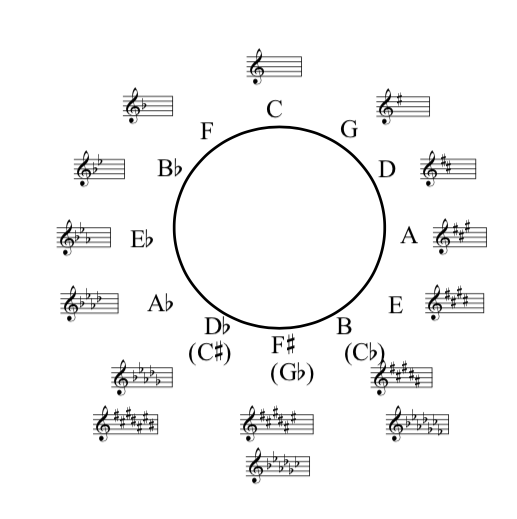
The sequence of sharp key signatures can include enharmonic equivalents, shown with smaller notes as alternative names. Using enharmonic scales, this sequence can also be reversed to form the sequence of flat key signatures. Both sequences ultimately lead back to C Major.
Enharmonic Sequences and the Circle of Fifths
The Circle of Fifths diagram helps visualize this relationship clearly. Reading the circle clockwise shows the sequence of key signatures with sharps. Reading counterclockwise shows the sequence with flats. Understanding this pattern allows you to predict key signatures quickly and see how all keys connect through enharmonic equivalents.
The Circle of Fifths diagram makes this easier to understand:
Clockwise → sharp key signatures
Counterclockwise → flat key signatures
Closing the Chapter
These are the key concepts for understanding major scales with sharps and flats and how the Circle of Fifths works. We also covered enharmonic scales and theoretical scales.
If you enjoyed this post and found it helpful, you can support my work with a small donation on Buy Me a Coffee. Your support allows me to continue creating lessons, writing posts, and uploading more resources for music learners. Thank you! ❤️
You can also find exercises for practicing key signatures and scales in my Etsy shop
2 thoughts on “Chapter 2: Understanding Enharmonic Scales, Theoretical Keys & the Circle of Fifths”
I was curious if you ever thought of changing the structure of your site?
Its very well written; I love what youve got to say.
But maybe you could a little more in the way of content so people could
connect with it better. Youve got an awful lot of text
for only having one or 2 pictures. Maybe you could space it out better?
Thank you so much for the comment and the feedback! I know, and I’ve been thinking a lot about changing the theme of the website. The truth is that I initially started the site for my students, to upload the theoretical part of the lesson—more like notes to be studied before moving on to the exercises/worksheets I have prepared for each post! However, since it has started to gain more attention, I’m trying to redesign the theme and make it more organized.
Thank you again for the feedback! I hope the change will be implemented in the new year!
I hope you continue to find useful information on the website!



I was curious if you ever thought of changing the structure of your site?
Its very well written; I love what youve got to say.
But maybe you could a little more in the way of content so people could
connect with it better. Youve got an awful lot of text
for only having one or 2 pictures. Maybe you could space it out better?
Thank you so much for the comment and the feedback! I know, and I’ve been thinking a lot about changing the theme of the website. The truth is that I initially started the site for my students, to upload the theoretical part of the lesson—more like notes to be studied before moving on to the exercises/worksheets I have prepared for each post! However, since it has started to gain more attention, I’m trying to redesign the theme and make it more organized.
Thank you again for the feedback! I hope the change will be implemented in the new year!
I hope you continue to find useful information on the website!
Best,
Helena